
Article • 7 min read
Mind Maps®
A Powerful Approach to Note-Taking
tMTCT
By the Mind Tools Content Team
Have you ever studied a subject or brainstormed an idea, only to find yourself with pages of information, but no clear view of how it fits together?
This is where Mind Mapping (also known as Mind Mapping, Concept Mapping, Spray Diagrams, and Spider Diagrams) can help.
Mind Mapping is a useful technique that supports learning, improves information recording, shows how different facts and ideas are related, and enhances creative problem solving. Read on to find out more.
What Are Mind Maps?
Mind Maps were popularized by author and consultant, Tony Buzan. They use a two-dimensional structure, instead of the list format conventionally used to take notes. This makes information easier to remember, as it's held in a format that our minds find easy to recall and quick to review.
A good Mind Map shows the "shape" of the subject, the relative importance of individual points, and the ways in which facts relate to one another. Research shows that this is of particular benefit when dealing with complex information, such as during business planning and strategy development.
Mind Maps are more compact than conventional notes, and often take up just one side of paper. This helps you to make associations and to generate new ideas. You can also add new information easily, even to a Mind Map that you've already drawn.
Mind Mapping can also help you to break down large projects or topics into manageable chunks, so that you can plan effectively without getting overwhelmed and without forgetting something important.
What Can I Use Mind Maps For?
Mind Maps are useful for:
Brainstorming – individually, and as a group.
- Summarizing information.
- Taking notes.
- Consolidating information from different sources.
- Thinking through complex problems.
- Presenting information clearly.
- Studying and memorizing information.
Mind Maps are also good for refreshing information in your mind. When you commit the shape and structure of a Mind Map to memory, you can often get the cues you need to remember the information it contains just by glancing quickly at the Map. Studies have shown that this makes them highly valuable when you're learning a language, for example.
You can really get inventive with Mind Maps, so they are great for boosting creativity, too. When you include colors, images or drawings, they can even resemble a work of art!
How to Draw a Basic Mind Map
To draw a Mind Map, follow these five steps:
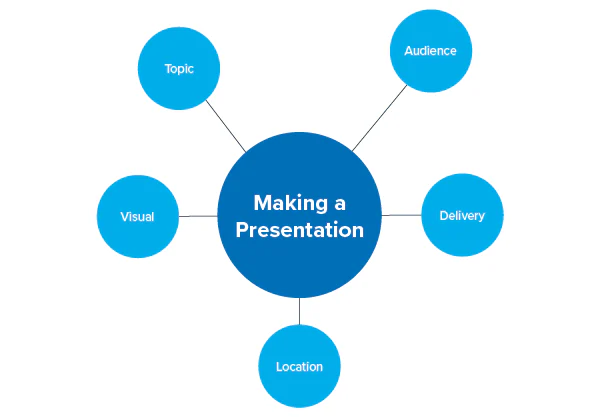
Step 1. Write the title of the subject or project that you're exploring in the center of a page and draw a circle around it, as shown in figure 1, below.
(Our simple example shows a Mind Map of the actions needed to deliver a successful presentation.)

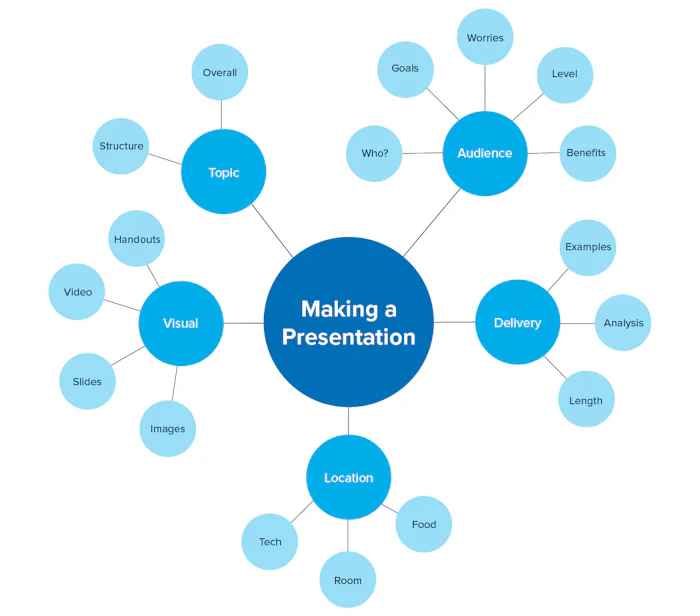
Step 2. Draw lines out from this circle as you think of subheadings of the topic or important facts or tasks that relate to your subject. Label these lines with your subheadings. (See figure 2, below.)
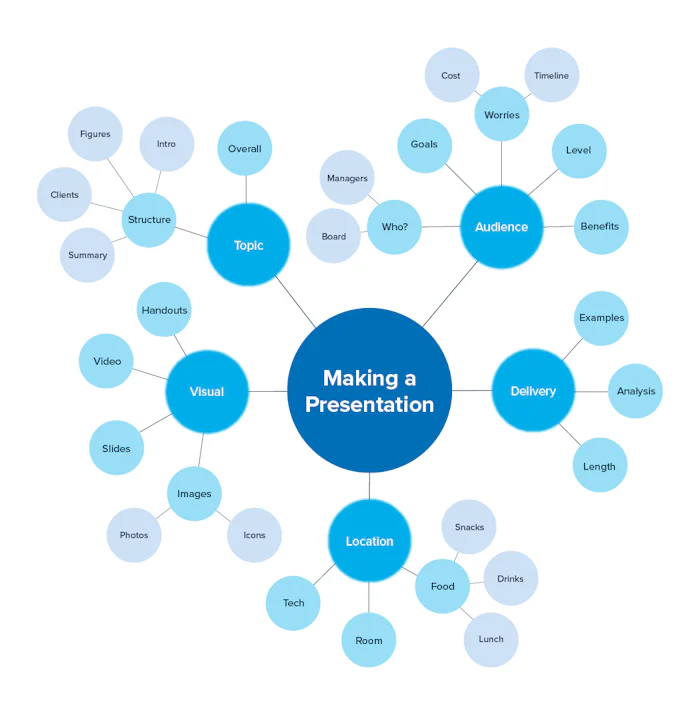
Step 3. Dive deeper into the subject to uncover the next level of information (related sub-topics, tasks or facts, for example). Then, link these to the relevant subheadings. (See figure 3, below.)
Step 4. Repeat the process for the next level of facts, tasks and ideas. Draw lines out from the appropriate headings and label them, as shown in figure 4, below.
Step 5. As you discover new information or think of additional tasks, add them to your Mind Map in the appropriate places.
A complete Mind Map may have main topic lines radiating in all directions from the center, with sub-topics forking off these like branches and twigs from the trunk of a tree. You don't need to worry about the structure you produce – this will evolve of its own accord.
Tip:
While drawing Mind Maps by hand is appropriate in many cases, software tools and apps like Mindmeister , and MindGenius, can improve the process by helping you to produce high-quality Mind Maps, which you can then easily edit or redraft.
How to Use Mind Maps Effectively
Once you understand how to take notes in the Mind Map format, you can develop your own conventions for taking them further. The following suggestions can help you to get the most from your Mind Maps:
- Use Single Words or Uncomplicated Phrases – Keep things simple. In Mind Maps, single strong words and short, meaningful phrases can convey the same meaning more potently. Excess words just clutter a Mind Map.
- Print Words – They will be easier to read than joined-up or indistinct writing.
- Use Color to Separate Different Ideas – Color can help to show the organization of the subject. It can also make your Mind Map a more appealing document, and help you to visualize the different sections of your Mind Map for future recall.
- Use Symbols and Images – Pictures can help you to remember information more effectively than words, so use symbols or pictures that mean something to you, use it. (You can use photo libraries like iStock to source images inexpensively.)
- Using Cross-Linkages – Information in one part of a Mind Map may relate to another part, so draw lines to show these cross-linkages. This will help you to see how one part of the subject affects another.
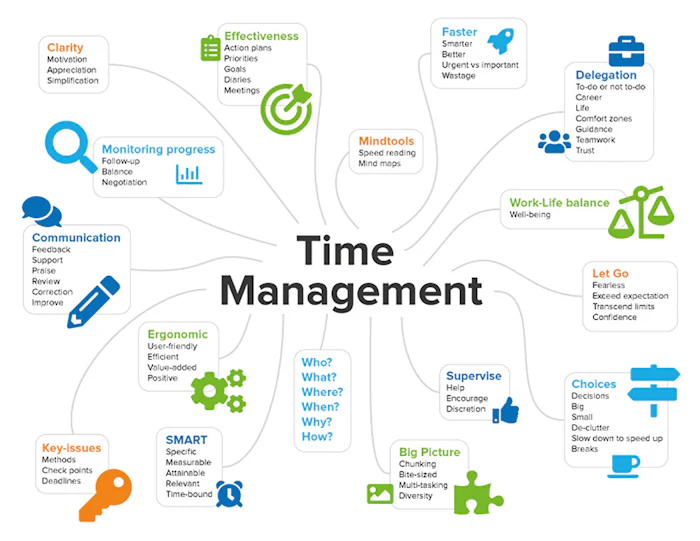
Visual Example
Click on the down arrow on the right-hand side below to download a PDF of this great example of a Mind Map with high visual impact:
137 KB
Key Points
Mind Mapping is a powerful note-taking method. Mind Maps not only highlight important facts, but also show the overall structure of a subject and the relative importance of individual parts of it.
They are great when you need to think creatively, and can help you to make new connections between ideas. This is useful when you have problems to solve.
To use Mind Maps effectively, it's best to print your words, to use different colors (to add visual impact), and to incorporate symbols and images to spur creative thinking.
If you do any form of research or note taking, try experimenting with Mind Maps. You'll love using them!
References
Buran, A. (2015). 'Mind Mapping Technique in Language Learning,' Social and Behavioral Sciences, 206, 215-218. Available here.
Buzan, T., and Buzan, B. (1996). The Mind Map Book: How to Use Radiant Thinking to Maximize Your Brains Untapped Potential. New York: Plume.
Somers, M., Passerini, K., Parhankangas, A., and Casal, J. (2014). 'Using Mind Maps to Study How Business School Students and Faculty Organize and Apply General Business Knowledge,' The International Journal of Management Education, 12(1), 1-13. Available here.
TRADEMARK INFORMATION
"Mind Map" is a trademark of the Buzan Organization (see www.tonybuzan.com) and used here with permission. We have no association with this organization.
You reach 1 of 2 of your free articles
Discover more content
Create an account to comment · Click hereOr Sign in here
Comments (0)
Be the first to comment!
Get ready for 2023 with our Life Plan
Join Mind Tools before Jan 17 and get unlimited access to 2500+ resources and a FREE Life Plan workbook!
Get the Free Newsletter!

Learn new career skills every week, plus get a bonus Take Control of Your Time, free!

