

 Until now, the prevailing Newtonian mechanistic worldview has dominated Western culture, science and metaphysics for hundreds of years. The idea that we live in an unintelligently designed universe – the idea that out of nowhere, nothing, for no reason spontaneously became everything, has been accepted as scientific gospel. This atheistic, nihilistic, purely materialistic paradigm presented by believers of Big Bang evolution, however, cannot explain the multitude of non-physical, non-local findings in quantum mechanics. They cannot explain how consciousness, intelligence and life supposedly evolved from unconscious, unintelligent, dead matter. They cannot explain why apple seeds grow apple trees and pear seeds grow pear trees, or how arm cells know to be arms and leg cells know to be legs. They cannot explain the holographic universe or morphogenic fields, the placebo effect, psychoneuroimmunology, acupuncture, the aura, chi/prana or remote healing; telepathy, psychokinesis, clairvoyance, precognition and the entirety of psi science; they cannot explain out-of body or near-death experiences, ghosts, entheogens, the soul, the spirit world or reincarnation.
 “Although the true nature of the Universe has been known and taught throughout the ages by many and varied sources throughout the world, all of which are highly consistent and in broad agreement, it is also now being substantiated by the work of modern quantum physics, and increasingly by other branches of the sciences as well. All areas of the sciences will surely soon have to accept the fact that true Universal reality is not and never can be based entirely in the familiar three-dimensional world of physical matter as has been assumed since the days of Isaac Newton, but is rather an infinite, multi-dimensional reality, a Universe of living Consciousness of which everyone and everything without exception is an integral and equal aspect. The true nature of the Universe will certainly challenge the perceptions of most people, if for no other reason that throughout the ages there has been a prevalent misperception of a ‘God’ who is completely separate from everyone and everything else in existence, and who ‘rules’ over ‘his’ three dimensional world of matter from high places.” -Adrian Cooper, “Our Ultimate Reality”
The emerging wisdom of spiritual science has rendered the atheist materialist paradigm extinct. Consciousness, life, the beautiful diversity, complexity and interconnectedness of nature and the universe are not the result of some random coincidental physical phenomenon. Remember, the odds against our universe containing the precise physical forces and attributes necessary to sustain life is one octillion to one. In other words, there is only a 1 in 1,000,000,000,000,000,000,000,000,000 chance that the universe was unintelligently designed. So if there is an intelligent designer, a creative force beyond all space, time and matter, what are the properties of this entity? Theologists and metaphysicians throughout history have agreed that this intelligent creative force must by definition be all-knowing (omniscient), all-powerful (omnipotent), and all-present (omnipresent). Furthermore, by definition if “God,” an omniscient, omnipotent, omnipresent being exists, then we all must be a part of it! In my Asbestos Head book I wrote:
 “Either God is causal, singular and separate – an outside entity somehow responsible for His own existence, the creation of the universe, and the creation of other beings to recognize Him, or existence is non-causal, plural, parts and whole of all that is with nothing outside Us because We’re all infinite self-reflexive pieces of God interacting, changing, acting out eternity.”
Many people are happy to accept the notion that God is some external entity like a bearded white man in the clouds who created us and watches over the universe like a cosmic fishbowl. Others are happy to accept that there is no God and the universe, consciousness, life, matter, space and time are all the result of a random spontaneous big bang accident. Personally, neither of these ideas have ever resonated with me, and both are relatively modern. If instead we consult the most ancient culture and the oldest texts in recorded history, the Indian Vedas, a very different story presents itself:
 “Here’s a parable, an analogy, which comes from India, from the Upanishads, and is thousands of years old. It presents a parabolic answer to the root question of all religion and philosophy (Who am I and what is this?), and does so in a way which everyone can relate to. In the beginning of the world (and though it probably had no ultimate ‘beginning’ as we think of them, you have to start somewhere), there was only Brahma. Being all there was, and therefore totally known to himself, Brahma soon realized that this totality of awareness would eventually become extremely boring . . . after all, when you know everything there is to know, then there’s no surprise, nothing to keep you interested. It’s like reading the same book for the seventy-eight millionth time. Anyway, since he was omnipotent (all-powerful), omniscient (all-knowing), and omnipresent (all-everywhere), Brahma decided to create a diversion for himself, a way of introducing the elements of surprise, intrigue and drama into his experience. He thought, ‘What would it be like to forget who I really am?’ So, he invented the game of cosmic hide-and-seek. According to the rules of this game, Brahma would pretend to break pieces of himself off from the whole so that to all appearances they would seem separate. That’s the ‘hide’ part. Then, as the apparently separate consciousness at the center of each of those apparently separate pieces, and through their apparently separate and unique perspectives, he would ‘seek’ to rediscover who he really was, which was, of course, everything. Imagine seeing yourself from an infinite number of different perspectives, each one initially ignorant of its relationship to all the rest. Imagine going to sleep and dreaming a different lifetime each night, each lasting for more or less years, each complete with the full range and variety of emotional life and death details. Imagine having the same dream but playing a different role in it each night, seeing it through different eyes each time. Well, guess who those apparently separate pieces are? Since there is only one I Am in the universe, one consciousness, it’s all a game of hide-and-seek, and each one of us is in the same state: I’m IT AND You’re IT!” -Roger Stephens, “A Dangerous Book” (22-23)
 Brahma, God, Tao, Universal Mind, the One, the Void, the Field, Infinite Consciousness, or whatever you want to call it, by definition is everything, exists everywhere, and is completely known to itself. Try to picture, if that was your reality, what would you do with your existence? What can you do with your existence as an omnipotent, omniscient, omnipresence with nothing unknown or outside yourself? There really is only one possibility. You play make-believe. Hide and seek.
Since you are the One objective infinite consciousness, to hide from yourself you must first divide your sense of self into several subjective finite packets of consciousness. At and as the root of each of these subjective packets of consciousness will be the feeling of “I am” and “I am not” – the feeling of existing as an individual entity separated from the totality. With that, the hiding part is complete.
The next step is creating a sensory rich, holographic, and ultimately illusory material world and physical bodies where these subjective awarenesses can interact, play and experience. To best accommodate this, since God is a singularity, the material world must be a world of duality, a world of polar opposites, where each soul, each individuated facet of God may experience the heights, depths, and breadth of possibility, so there must exist both good and evil, male and female, positive and negative, pleasure and pain, birth and death, inhale and exhale, black and white, dark and light, day and night, sun and moon, yin and yang, intelligence and ignorance and so on and so forth.
 The one golden rule and driving force of God’s universal hide and seek game is called karma, or cause and effect, what goes around comes around, do unto others as you would have done unto yourself, because fundamentally there is no “you” or “others,” there is only God, the one true Self. Your physical body, your name, your entire human identity and the feeling of being an individual entity separated from the totality is a secondary and ultimately illusory experience of the One true being. Your feeling of being Tom, Dick or Harry is a purposely induced state of amnesia so that the creator may experience His creation. Each subjective packet of consciousness, each soul, ultimately is and wishes to reunite with the One, Tao, God, Brahma. But life as Brahma, to be honest, gets boring and sometimes Brahma would rather play hide and seek. God wants to experience through you what it is like to be you, a fractal fragment of Himself. Thus begins lifetimes of cyclical hiding and seeking, karmic creation and destruction, moving away from and back towards God, your true Self.
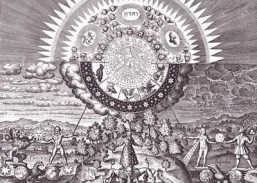 “In the Eastern view, then, the division of nature into separate objects is not fundamental and any such objects have a fluid and ever-changing character. The Eastern world view is therefore intrinsically dynamic and contains time and change as essential features. The cosmos is seen as one inseparable reality – for ever in motion, alive, organic; spiritual and material at the same time. Since motion and change are essential properties of things, the forces causing the motion are not outside the objects, as in the classical Greek view, but are an intrinsic property of matter. Correspondingly, the Eastern image of the Divine is not that of a ruler who directs the world from above, but of a principle that controls everything from within: He who, dwelling in all things, Yet is other than all things, Whom all things do not know, Whose body all things are, Who controls all things from within – He is your Soul, the Inner Controller, The Immortal.” -Fritjof Capra, “The Tao of Physics” (24-5)
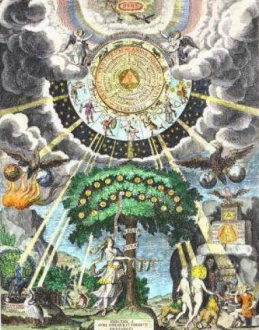 “Think of the difference between a droplet of water and the ocean; the droplet symbolizes the sense of division, of being an individual ‘me’, unconnected to anything else. This is like identifying with being ‘Bill Bloggs’ or ‘Ethel Jones’. But, put that droplet back in the ocean, and where does the ocean end and the droplet begin? There is no beginning and no end, no Alpha and Omega, because all is One. At that level there is no ‘we’ – only an Infinite ‘I’. Part of that ocean may be calm and peaceful and another may be angry and rough, but it is still the same ocean, the same Oneness. We are always the ocean, always Infinite Awareness, and we cannot literally become disconnected from that. However, when we forget who we are, we can be confused into a sense of division, of being the droplet, and we perceive reality through the tiny lens that this creates in our minds … We are the ocean, Infinite Awareness, but we believe we are just a little powerless, insignificant droplet. We identify with division and ‘parts’, not unity.” –David Icke, “The David Icke Guide to the Global Conspiracy” (3)
Another way to understand this concept is through dreams. In dreams you create entire worlds, environments, situations, and even other people. You interact and converse, create conflict and resolutions, get emotional and involved, but suddenly when you wake up from the dream you realize that all those environments, situations, and other people were really all you! They only seemed like separate individuals because of the level of consciousness you were operating on at the time. It is the same in this world, where you think you are a separate person, but in fact when you die, a piece of God wakes up to realize He was only dreaming.
 “To many, the statement ‘I am God’ rings of blasphemy. God, according to conventional religion, is the supreme deity, the almighty eternal omniscient creator. How can any lowly human being claim that he or she is God? Yet when mystics say ‘I am God,’ or words to that effect, they are not talking of an individual person. Their inner explorations have revealed the true nature of the self, and it is this that they identify with God. They are claiming that the essence of self, the sense of ‘I am’ without any personal attributes, is God. The contemporary scholar and mystic Thomas Merton put it very clearly: If I penetrate to the depths of my own existence and my own present reality, the indefinable am that is myself in its deepest roots, then through this deep center I pass into the infinite I am which is the very Name of the Almighty. ‘I am’ is one of the Hebrew names of God, Yahweh. Derived from the Hebrew YHWH, the unspeakable name of God, it is often translated as ‘I AM THAT I AM.’ Similar claims appear in Eastern traditions. The great Indian sage Sri Ramana Maharshi said: ‘I am’ is the name of God… God is none other than the Self. In the twelfth century, Ibn-Al-Arabi, one of the most revered Sufi mystics, wrote: If thou knowest thine own self, thou knowest God. Shankara, the eighth-century Indian saint, whose insights revitalized Hindu teachings, said of his own enlightenment: I am Brahman… I dwell within all beings as the soul, the pure consciousness, the ground of all phenomena… In the days of my ignorance, I used to think of these as being separate from myself. Now I know that I am All.” -Peter Russell, “From Science to God”
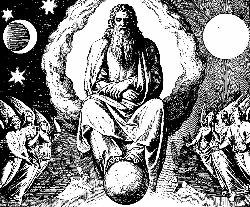 Since people always misinterpret the phrase “I am God,” I prefer to explain it as “I am, is God.” The self-awareness and continuity of being expressed by the words “I am,” our inner witness and intuition, is our direct channel to God. It is undeniable that if God is omnipresent, then He must exist in you, He must be you, and everyone and everything else in existence as well. We are all playing an equal part as lost ripples in God’s infinite ocean of consciousness.
“There is a Hindu myth that human consciousness began as a ripple that decided to leave the ocean of ‘consciousness as such, timeless, spaceless, infinite and eternal.’ Awakening to itself, it forgot that it was a part of this infinite ocean, and felt isolated and separated. Adam and Eve’s expulsion from the Garden of Eden may also be a version of this myth, an ancient memory of how human consciousness, somewhere in its unfathomable past, left its home in the implicate and forgot that it was a part of the cosmic wholeness of all things. In this view the earth is a kind of playground in which one is free to experience all the pleasures of the flesh provided one realizes that one is a holographic projection of a higher-order.” -Michael Talbot, “The Holographic Universe” (300)
 In the Judaic Kabbalistic belief this concept is present as the entirety of creation is seen as “an illusory projection of the transcendental aspects of God.” In Christianity it is said the Father and Son are one, thy Father art in heaven (the non-physical) but the Son lives in the flesh (the physical). The Father is Brahman, the ultimate objective implicate reality, and the Son is Atman, a fractal fragment of the One sent to experience and enjoy the Father’s creation. The Mother Mary is nature, or Mahamaya, the sustainer of the material world. She is the illusion maker, the agent of change, keeping all things from atoms to galaxies in constant motion and flux between polarities. It is her dynamic endless dance of forms which keeps us from realizing that there is ultimately no such thing as separateness. The Upanishads state that “one should know that nature is an illusion (maya), and that Brahman is the illusion maker. This whole world is pervaded with beings that are parts of him.”
 “The basic recurring theme in Hindu mythology is the creation of the world by the self-sacrifice of God -‘sacrifice’ in the original sense of ‘making sacred’- whereby God becomes the world which, in the end, becomes again God. This creative activity of the Divine is called Ma, the play of God, and the world is seen as the stage of the divine play. As long as we confuse the myriad forms of the divine with reality, without perceiving the unity of Brahman underlying all these forms, we are under the spell of maya. Maya, therefore, does not mean that the world is an illusion, as is often wrongly stated. The illusion merely lies in our point of view, if we think that the shapes and structures, things and events, around us are realities of nature, instead of realizing that they are concepts of our measuring and categorizing minds. Maya is the illusion of taking these concepts for reality, of confusing the map with the territory. In the Hindu view of nature, then, all forms are relative, fluid and ever-changing maya, conjured up by the great magician of the divine play.” -Fritjof Capra, “The Tao of Physics” (87-8)
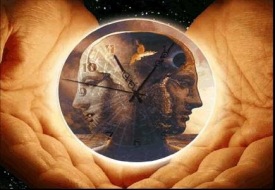 In the Vedanta our individual souls, our separate subjective packets of “I am” consciousness are called “atman” and the One unified objective infinite wellspring of consciousness from which everyone’s atman arises is “Brahman.” Atman is our divided, dualistic self and Brahman is our whole true Self, but fundamentally it is taught that Atman is Brahman and Brahman is Atman. Your true Self beyond this earthly identity is not divided and dualistic, your true Self is not separate and subjective, your true Self is not Jack, Jill, Joe, Jen, Jim, John, James or Jason, your true Self is the same as my true Self as everyone’s true Self is God.
“This ultimate reality is called ‘Brahman’ and is exactly the same as ‘The One’, ‘The All’, Spirit, ‘everything that is’, and in the West might be regarded as the true definition of ‘God’. Brahman, Universal Consciousness, considered to be the ultimate reality, is infinite, exists beyond the five physical senses and is incomprehensible. Most ancient wisdoms of the world teach that human beings are ‘God’ in the microcosm, immortal Spirits ‘made’ in the ‘true image of God’. Hinduism teaches the same principle in the form of ‘Atman’ which is equivalent to the human Soul. The Hindu culture teaches Atman and Brahman, the individual reality and the ultimate reality are one.” -Adrian Cooper, “Our Ultimate Reality” (26-7)
“The Hindus call the implicate level of reality Brahman. Brahman is formless but is the birthplace of all forms in visible reality, which appear out of it and then enfold back into it in endless flux. Like Bohm, who says that the implicate order can just as easily be called spirit, the Hindus sometimes personify this level of reality and say that it is composed of pure consciousness. Thus, consciousness is not only a subtler form of matter, but it is more fundamental than matter; and in the Hindu cosmogony it is matter that has emerged from consciousness, and not the other way around.” -Michael Talbot, “The Holographic Universe” (288
 Finally, quantum physicists like David Bohm and consciousness researchers like Peter Russell have now proven what the world’s most ancient spiritual teachings have long espoused for thousands of years – the faculty of consciousness is primary to the creation of the material world. A conscious observer must first exist to collapse the wave function allowing particles to manifest into the explicate reality. This means that before the creation of the material world there must have existed a self-aware conscious observer (God) and every physical manifestation is actually the result of His conscious creation.
“The basic elements of the world view which has been developed in all these traditions are the same. These elements also seem to be the fundamental features of the world view emerging from modern physics. The most important characteristic of the Eastern world view – one could almost say the essence of it – is the awareness of the unity and mutual interrelation of all things and events, the experience of all phenomena in the world as manifestations of a basic oneness. All things are seen as interdependent and inseparable parts of this cosmic whole; as different manifestations of the same ultimate reality. The Eastern traditions constantly refer to this ultimate, indivisible reality which manifests itself in all things, and of which all things are parts. It is called Brahman in Hinduism, Dharmakaya in Buddhism, Tao in Taoism. Because it transcends all concepts and categories, Buddhists also call it Tathata, or Suchness: What is meant by the soul as suchness, is the oneness of the totality of all things, the great all-including whole. In ordinary life, we are not aware of this unity of all things, but divide the world into separate objects and events. This division is, of course, useful and necessary to cope with our everyday environment, but it is not a fundamental feature of reality. It is an abstraction devised by our discriminating and categorizing intellect. To believe that our abstract concepts of separate ‘things’ and ‘events’ are realities of nature is an illusion. Hindus and Buddhists tell us that this illusion is based on avidya, or ignorance, produced by a mind under the spell of maya. The principal aim of the Eastern mystical traditions is therefore to readjust the mind by centering and quietening it through meditation. The Sanskrit term for meditation Samadhi – means literally ‘mental equilibrium’. It refers to the balanced and tranquil state of mind in which the basic unity of the universe is experienced: Entering into the samadhi of purity, one obtains all-penetrating insight that enables one to become conscious of the absolute oneness of the universe.” -Fritjof Capra, “The Tao of Physics” (130-1)

 Receiving direct knowledge or perception of the future, Precognition, is another common psi ability with a long-standing history. Precognition is usually achieved through prophetic dreams, during deep meditation, or spontaneously received as images in the mind’s eye. The existence of this paranormal ability, however, once again goes against the Newtonian grain and strikes close to the heart of people’s conceptions of time and free will. Because if precognition is real, then the future must in some sense be pre-written and determined.
 “Both in common experience and in physics, time has generally been considered to be a primary, independent and universally applicable order, perhaps the most fundamental one known to us. Now, we have been led to propose that it is secondary and that, like space, it is to be derived from a higher-dimensional ground, as a particular order.” -David Bohm
 I have personally experienced Precognition on a few occasions but none as amazing or memorable as the following. During college I had what seemed to be a normal dream involving myself and my friend, wearing our typical attire, talking outside my dorm about what we wanted to do that day. Now I didn’t remember even having the dream until the next day as my friend and I were approaching my dorm; every word she said started triggering the clearest, most mind-blowing déjà vu as the dream came flooding back to me. We were both wearing the same clothes I’d envisioned, we were standing in the same place, and every word she said was exactly as I had dreamt. Seizing the opportunity to test and manifest this amazing clarity of déjà vu I was experiencing, I quickly blurted out the entire next sentence that I knew she would be saying and matched her word for word in real time! Stunned at my simultaneous telepathic mocking, she abruptly stopped talking and I laughed uncontrollably trying to explain the whole thing.
 That and many other precognitive experiences forever changed my perception of the arrow of time. If time is truly linear then we can only remember the past and cannot in any way remember the future. But if it is impossible to remember the future, then what was my dream? How was I able to vividly see and remember the entire scenario in precise detail the night before it happened? I guarantee anyone who felt my paradigm-crushing déjà vu, would agree that this synchronicity was far beyond some quirky coincidence.
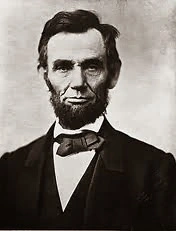 President Lincoln dreamt of his own assassination a week before he died. British Aeronautics Engineer J.W. Dunne documented several prophetic dreams come true in his 1927 book “An Experiment with Time.” There are even 19 documented cases of people who precognitively saw the sinking of the Titanic. Some by passengers who acknowledged their premonitions and survived, others by passengers who ignored their intuition and drowned, and others still by non-passengers.
 Swedish scientist/mystic Emanuel Swedenborg had a gift for precognition and documented many independently verified examples. One evening, on June 19th, 1759 upon arriving at a dinner party in Goteborg, Swedenborg had a vision of Stockholm burning 300 miles away. He told everyone in attendance including the mayor about the blazing fire and that it had stopped only 3 doors from his home. The next day a messenger from Stockholm arrived and confirmed Swedenborg’s incredible vision.
 “For instance, on January 6, 1969, in a study conducted by Dr. Jule Eisenbud, a clinical professor of psychiatry at the University of Colorado Medical School, Croiset was told that a chair had been chosen for an event that would take place on January 23, 1969. Croiset, who was in Utrecht, Holland, at the time, told Eisenbud that the person who would sit in the chair would be a man five feet nine inches in height who brushed his black hair straight back, had a gold tooth in his lower jaw, a scar on his big toe, who worked in both science and industry, and sometimes got his lab coat stained by a greenish chemical. On January 23, 1969, the man who sat down in the chair, which was in an auditorium in Denver, Colorado, fit Croiset’s description in every way but one. He was not five feet nine, but five feet nine and three-quarters.” -Michael Talbot, “The Holographic Universe” (207)
 Psi-researcher Dean Radin highlighted the interesting case of Anne Ring in his “Entangled Minds” book. She sent him the following in a letter: “Many years ago I had a very strange dream concerning my father. I dreamt that he was decorating the house (the way we do in England – or used to – with paper chains, holly, etc.). Except the decorations he was using were not the type used for Christmas. Suddenly he sat down on a chair and collapsed and he died. I woke up crying so loudly that it woke up my husband. I looked at the clock and it was exactly 2 a.m. California time. I told my husband the dream and he just said, ‘Well it’s nothing, you are always having strange dreams, go back to sleep.’ But the dream had disturbed me and it took a long while for me to get back to sleep. The following morning was Thanksgiving Day and as I was preparing the meal the telephone rang and it was my brother calling from London to say my father had died. It was a terrible shock because I had seen him in May of that year and he was in robust health (in fact, he had not ever been ill or in hospital in his life). I asked my brother when it had happened and he replied that our stepmother had just called him and told him it had happened at 10 a.m. London time: The exact moment that I had the dream (2 a.m. California time). By the way, he was putting up decorations because it was his wedding anniversary to my stepmother and they were going to have a party that night.”
 “How shall we interpret this experience? Is it a poignant coincidence or is it a case of genuine clairvoyance? This was the one and only time Mrs. Ring ever had a dream like this, and it contained details and timings that matched real-world events. I’ve been told similar experiences by professors at major universities, by program directors at the NSF, and by generals in the Army. These are not naïve people prone to fantasy. They appreciate the difference between meaningless coincidence and genuinely exceptional events.” -Dean Radin, “Entangled Minds” (105)
 The most rigorous scientific study of dream psi ever took place at the Maimonides Medical Center in Brooklyn, New York. Over the course of several years, Psychologists Montague Ullman and Stanley Krippner ran hundreds of in-house and at-home dream sessions with thousands of volunteers. Experiments usually involved trying to predict random images chosen by computer and displayed overnight in a locked room at the dream lab. Each day volunteers attempted to dream of tomorrow’s picture then recorded their impressions for Ullman and Krippner to cross-check. In 2003 when British psychologists Simon Sherwood and Chris Roe performed a meta-analysis of all the Maimonides dream psi results they found that the overall hit rate was associated with odds against chance of 22 billion to 1.
 “In his work at the Dream laboratory at Maimonides Medical Center, Montague Ullman, along with psychologist Stanley Krippner and researcher Charles Honorton, produced compelling evidence that accurate precognitive information can also be obtained in dreams. In their study, volunteers were asked to spend eight consecutive nights at the sleep laboratory, and each night they were asked to try to dream about a picture that would be chosen at random the next day and shown to them. Ullman and his colleagues hoped to get one success out of eight, but found that some subjects could score as many as five ‘hits’ out of eight. For example, after waking, one volunteer said that he had dreamed of ‘a large concrete building’ from which a ‘patient’ was trying to escape. The patient had a white coat on like a doctor’s coat and had gotten only ‘as far as the archway.’ The painting chosen at random the next day turned out to be Van Gogh’s Hospital Corridor at St. Remy, a watercolor depicting a lone patient standing at the end of a bleak and massive hallway exiting through a door beneath an archway.” -Michael Talbot, “The Holographic Universe” (206)
 Other evidence such as
  One of the most convincing and astonishing proofs of precognition was discovered when University of Amsterdam’s Dr. Dick Bierman hooked several poker players to electrodermal instruments to test learned responses in gambling addicts. He found that they all registered rapid changes in electrodermal activity just before being handed their cards. Not only this but the differences in EDA corresponded with the type of cards being drawn. When about to receive a bad hand participants showed physiological activity indicating a heightened fight or flight response. When about to receive a favorable hand their EDA calmed towards a relaxation response. This indicates that on a subconscious physiological level, somehow we already “know” the future.
 “As expected, the participant’s body would calm down immediately after he or she observed the tranquil scenes, and become aroused after being confronted by the erotic or disturbing. Naturally, study participants recorded the largest response once they’d seen the photos. However, what Radin discovered was that his subjects were also anticipating what they were about to see, registering physiological responses before they’d seen the photo. As if trying to brace themselves, their responses were highest before they saw an image that was disturbing. Blood pressure would drop in the extremities about a second before the image was flashed.” -Lynne McTaggart, “The Field: The Quest for the Secret Force of the Universe,” (169)
 Nobel laureate Kary Mullis had the opportunity to participate in Dean Radin’s presentiment experiment and was quite impressed with the results. He went on National Public Radio’s May 1999 Science Friday program afterwards stating, “I could see about 3 seconds into the future. It’s spooky. You sit there and watch this little trace, and about three seconds, on average, before the picture comes on, you have a little response in your skin conductivity which is in the same direction that a large response occurs after you see the picture. Some pictures make you have a rise in conductivity, some make you have a fall. He’s done that over and over again with people. That, with me, is on the edge of physics itself, with time. There’s something funny about time that we don’t understand because you shouldn’t be able to do that.”
 In ordinary states of consciousness and without the aid of technology most people are able to remember the past but not the future. This has led to the philosophical idea of an “arrow of time” shooting from past to future with us riding along the present. In altered states of consciousness or with the aid of technology, however, many people, myself included, have been able to experience and remember future events in detail. Perhaps then it is more likely that time, as our ancient ancestors believed, is cyclic and infinite, not straight and finite. It seems that ultimately, our consciousness exists outside of
  “Such incidents strongly suggest that the future is not set, but is plastic and can be changed. But this view also brings with it a problem. If the future is still in a state of flux, what is Croiset tapping into when he describes the individual who will sit down in a particular chair seventeen days hence? How can the future both exist and not exist? Loye provides a possible answer. He believes that reality is a giant hologram, and in it the past, present, and future are indeed fixed, at least up to a point. The rub is that it is not the only hologram. There are many such holographic entities floating in the timeless and spaceless waters of the implicate, jostling and swimming around one another like so many amoebas. ‘Such holographic entities could also be visualized as parallel worlds, parallel universes,’ says Loye. Thus, the future of any given holographic universe is predetermined, and when a person has a precognitive glimpse of the future, they are tuning into the future of that particular hologram only. But like amoebas, these holograms also occasionally swallow and engulf each other, melding and bifurcating like the protoplasmic globs of energy that they really are. Bohm’s and Loye’s descriptions seem to be two different ways of trying to express the same thing – a view of the future as a hologram that is substantive enough for us to perceive it, but malleable enough to be susceptible to change. Others have used still different words to sum up what appears to be the same basic thought. Cordero describes the future as a hurricane that is beginning to form and gather momentum, becoming more concrete and unavoidable as it approaches. Ingo Swann, a gifted psychic who has produced impressive results in various studies, including Puthoff and Targ’s remote-viewing research, speaks of the future as composed of ‘crystallizing possibilities.’ The Hawaiian kahunas, widely esteemed for their precognitive powers, also speak of the future as fluid, but in the process of ‘crystallizing,’ and believe that great world events are crystallized furthest in advance, as are the most important events in a person’s life, such as marriage, accidents, and death.” -Michael Talbot, “The Holographic Universe” (211-212)
 “Remote viewing is broadly speaking a controlled shifting of awareness performed from the normal waking state of consciousness … Humans are all part of a collective Mind existing beyond the limitations of physical space and time. Anyone who is focused into this ‘dimension’, ‘plane’ or ‘state,’ which is a level of energy or vibration, either permanently or temporarily, can potentially project their consciousness anywhere within time or space in an instant. Remote viewing works therefore by means of the ‘remote viewer’ projecting, or tuning their consciousness into this spaceless and timeless aspect of the universe.” -Adrian Cooper, “Our Ultimate Reality” (130)
 The term “Remote Viewing” was coined in the early 1970s by Stanford Research Institute’s physicists Russell Targ and Harold Puthoff. In their experiments, one person (the “agent”) would travel to a distant location randomly selected by computer, while another person (the “viewer”) would attempt to clairvoyantly see and describe where the agent went. In Targ and Puthoff’s initial experiments, one Soviet psychic was consistently able to accurately describe several locations, sometimes before the agent arrived, and sometimes before the computer had even made the selection! Throughout twenty years of research they carried out hundreds of successful tests using several different viewers and even demonstrated these feats on live television including on 60 Minutes and the Donahue show.
 “In these carefully controlled experimental tests spanning two decades, many different subjects sat in a windowless office, closed their eyes, and explored the world outside. These individuals were consistently able to experience and accurately describe distant scenes and events from coast-to-coast and even continent-to-continent, in both present and future time. The SRI experiments demonstrated unequivocal evidence for extrasensory perception and the existence of the nonlocal mind, outside the brain and body. The ability of human awareness to make remarkable connections apparently transcends the conventional limitations of time and space.” -Russell Targ and Jane Katra, “Miracles of Mind” (6)
 One day in 1973 Targ and Puthoff were contacted by Burbank, California Police Commissioner Pat Price who had been closely following their work and wanted to help. Price said that he had been practicing clairvoyance for years and successfully using it in his police work to catch criminals. Whenever dispatch reported a crime he would sit in his office, close his eyes, and psychically scan the city looking for someone matching the description. Once he pin-pointed their location in his mind’s eye, he would send out a car to check, and actually succeeded in catching several criminals this way.
 “Price took over as chief remote viewer. Hal and Russ underwent nine trials with him, following their usual double-blind protocol of sealed target spots near Palo Alto – Hoover Tower, a nature preserve, a radio telescope, a marina, a toll plaza, a drive-in movie theater, an arts and crafts plaza, a Catholic church and a swimming pool complex. Independent judges concluded that Price had scored seven hits out of the nine. In some cases, like the Hoover Tower, Price even recognized it and correctly identified it by name. Price was noted for his incredible accuracy.” -Lynne McTaggart, “The Field: The Quest for the Secret Force of the Universe,” (153)
 Through SRI the CIA got wind of Price’s skills and initiated the now declassified Projects “GrillFlame” and “Scanate” in an attempt to clairvoyantly spy on sensitive targets. Price was given nothing but the latitude and longitude of a remote location and asked to describe all details that he could see. With unwavering confidence Pat polished his glasses, sat back in his chair, closed his eyes and began recounting what he saw. It was a military airfield with a few buildings scattered around. There was a large 8 wheeled gantry set upon tracks, a big cluster of compressed gas cylinders at one end, and inside the buildings were masses of steel gores. Price then opened his eyes and drew pictures of the building layout, the cylinders, the gantry, and gores. When the results came back from CIA spy satellites and ground Intel, it turned out that the target site was indeed a Soviet military airfield and nuclear testing area in Semipalatinsk, Kazakhstan. The building layout, cylinders, 8 wheeled gantry, and even the steel gores inside were all confirmed to be just as Price described.
 Sadly Pat Price died in 1975, but Targ and Puthoff continued their remote viewing projects and in 1978 met someone they later described as “the greatest natural psychic ever to walk into our laboratory,” US Army Special Projects Intelligence Officer Joe McMoneagle. A highly decorated and esteemed soldier, Joe McMoneagle had survived a near-death experience and had many out-of-body experiences which piqued his interest in remote viewing. He said the experience of leaving and looking down on his own body started him on his psychic journey and forever changed his metaphysics.
 For his first experiment at SRI, Joe was told only that he would be viewing a “technological” target within 100 miles of the San Fransisco Bay Area (which is full of possible technological locations such as military bases, airports, factories, power plants, cell towers, linear accelerators, radar installations and radio telescopes). The actual target was the Lawrence Livermore Laboratory, the famous hydrogen bomb research facility directed by Edward Teller. Without hesitation Joe picked up his pencil and began drawing what he saw in his mind’s eye: the multipurpose laboratory complex, segmented one-story buildings nearby, the six-story administration building, a T-shaped building, a cylindrical roofed building and a large parking lot. When Joe’s drawing was finished it was independently deemed as 85% accurate.
 In perhaps his most impressive viewing session on record, Joe was given absolutely no feedback whatsoever about where the agent would be traveling and he was able to draw an astonishing resemblance independently verified as 94% accurate. The target was a windmill farm in the foothills of Livermore Valley, and that’s exactly what Joe drew: Multiple wind generators, rotating blades, with poles scattered amongst the hills all connected in a grid.
 In her 1995 CIA funded evaluation of all Remote Viewing experiments conducted since 1970, Dr. Jessica Utts concluded that: “Using the standards applied to any other area of science it is concluded that psychic functioning has been well established. The statistical results of the studies examined are far beyond what is expected by chance. Arguments that these results could be due to methodological flaws in the experiments are soundly refuted. Effects of similar magnitude to those found in government-sponsored research at SRI and SAIC have been replicated at a number of laboratories across the world. Such consistency cannot readily be explained by claims of flaws or fraud.”
 In addition to SRI’s studies, Princeton University’s Engineering Anomalies Research (PEAR) Laboratory also conducted 25 years of remote viewing research with 653 trials involving 72 participants. Headed up by Dean of Engineering Robert Jahn and psychologist Brenda Dunne, in a 2003 meta-analysis they summarized their findings regarding the evidence for remote viewing. Their overall assessment showed with odds against chance of 33 million to 1, the results were definitely not due to luck or coincidence. Jahn and Dunne concluded, “the overall results of these analyses leave little doubt, by any criterion, that the data contain considerably more information about the designated targets than can be attributed to chance guessing.”
 “In the 1980s, I worked on a top secret psi research program for the U.S. government (now declassified). At the first research briefing I attended, I was shown examples of high-quality remote viewing obtained under exceptionally well-controlled circumstances. I asked in amazement, ‘Why is psi still considered controversial by the scientific mainstream? Why not just conduct an experiment of 20 or 30 trials with this type of remote viewing skill? That ought to convince anyone that psi is real.’ The answer, explained to me patiently by physicist Ed May, was simple. He said, ‘You’re making the rational man mistake.’ He meant that we usually assume science is a rational process, but it’s not … The technical term for one form of this irrational phenomenon is the ‘confirmation bias.’ This psychological quirk causes evidence supporting your beliefs to be perceived as plausible, and evidence challenging your beliefs to be perceived as implausible. Studies in social psychology have repeatedly demonstrated that journal reviewers invariably judge articles being submitted for publication according to their prior beliefs. Those who agree with a hypothesis tend to judge a paper reporting positive results as an excellent piece of work, and those who disagree judge the very same paper as a flawed failure. The former referees recommend publication and the latter don’t. The final decision is left up to the editor, so if the editor doesn’t happen to agree with the paper’s hypothesis then there’s a good chance it won’t appear in the journal. And then the evidence doesn’t exist as far as the rest of the scientific community is concerned.” -Dean Radin, “Entangled Minds” (101-2)
 The ability of remote viewing raises some interesting questions and serious objections regarding the scientific materialist paradigm. Traditionally science has explained the miracle of sight as a purely material process taking place in the eyes and brain; however, this obviously conflicts with the research done at SRI and PEAR. Anyone trained in remote viewing or anyone who has experienced out-of-body travel and witnessed looking down upon their own sleeping body would have to agree that there must be something much more mystical and immaterial responsible for vision.
 Life magazine once featured Rosa Kuleshova, a Russian girl who could read perfectly clearly using her fingertips. The Russian Academy of Science tested her repeatedly under controlled conditions and concluded that her abilities were genuine. Italian Doctor Cesare Lombroso wrote about a blind patient who could see using her earlobe. Harvard Doctor David Eisenberg even published an article about two Chinese girls who can read using their armpits!
 “Despite our unwavering conviction that we see with our eyes, reports persist of individuals who possess, ‘eyeless sight,’ or the ability to see with other areas of their bodies. Recently David Eisenberg, M.D., a clinical research fellow at the Harvard Medical School, published an account of two school-age Chinese sisters in Beijing who can ‘see’ well enough with the skin in their armpits to read notes and identify colors. In Italy the neurologist Cesare Lombroso studied a blind girl who could see with the tip of her nose and the lobe of her left ear. In the 1960s the prestigious Soviet Academy of Science investigated a Russian peasant woman named Rosa Kuleshova, who could see photographs and read newspapers with the tips of her fingers, and pronounced her abilities genuine … Now, because every part of a hologram contains the whole, every part of the body – the hand, toe, knee – has the ability to pass frequency patterns to the brain, which it transforms into holograms that we can ‘see’. This means that people really do have eyes in their backsides. I have heard some people speak of being able to see 360 degrees when they have entered altered states of consciousness that make them more attuned to these senses by withdrawing their focus from the five-sense consensus reality. All this is perfectly explainable from the holographic perspective.” -Michael Talbot, “The Holographic Universe” (236-7)
 One of the most well-researched and fascinating branches of psi science is active-psi or Psychokinesis (PK). Also known as Telekinesis and mind over matter, PK is the ability to mentally influence a physical system or object. The most common method to test for active-psi is to isolate a volunteer from a target such as an inanimate object or a random system like a coin toss, dice roll or radioactive decay, then see if the person can mentally influence the target in a repeatable manner.
 “The dice-tossing experiment is the epitome of simplicity. A die face is chosen in advance, then one or more dice are tossed while a person wishes for that face to turn up. If the person’s intention matches the resulting die face, then a ‘hit’ is scored. If more hits are obtained than expected by chance over many dice tosses, that’s evidence for PK. In 1989, when psychologist Diane Ferrari and I were at Princeton University, we used meta-analysis to assess the combined evidence for PK effects in dice experiments. We searched all the relevant English-language journals for the dice experiments published from the 1930s to 1989 … We found 73 relevant publications, representing the efforts of 52 investigators from 1935 to 1987. Over that half-century, some 2,500 people attempted to mentally influence 2,600,000 dice throws in 148 different experiments, and just over 150,000 dice-throws in 31 control studies where no mental influence was applied to the dice … The odds that the dice studies were due to chance alone were 10^96 to 1 (that’s 10 with 96 zeros after it). By contrast, the results of control experiments were well within chance expectation. So something else was clearly going on.” -Dean Radin, “Entangled Minds” (149)
 When self-professed so-called rational, logically-minded “skeptics” hum and haw about the amazing findings in
  “If all this is true, then why aren’t the casinos going out of business? And why don’t prayers work more reliably? The truth is that no one knows – yet. These experiments suggest that mind and matter are indeed related to a small degree that is statistically repeatable under controlled conditions. But we’ve barely scratched the surface of a phenomenon that’s still profoundly mysterious. So offering answers to all the ‘but why’ questions evoked by these data, given our present state of knowledge, is terribly premature. I think a more reasonable question to ask at this point is: If the results of the dice experiments suggest a genuine mind-matter interaction, then there ought to be corroborating evidence from similar experiments using other types of physical targets. And there is.” -Dean Radin, “Entangled Minds” (153)
 Another popular type of PK experiment involves using Random Number Generators (RNGs) which are simple machines that electronically generate up to thousands of random 0’s or 1’s (heads or tails) every second moving an indicator light either one step clockwise or one step counterclockwise. A volunteer then attempts to mentally influence the RNG outputs by willing more clockwise results (like “heads” known as the “high aim condition”) or more counterclockwise results (like “tails” called the “low aim condition”). In 1997, after 12 years of RNG experiments at their Princeton Engineering Anomalies Research Laboratory (PEAR Lab), lead engineer Robert Jahn and his team formally published their findings. It seems when volunteers mentally intended for high aim conditions, the RNG outputs invariably drifted more clockwise above chance expectation. When volunteers intended for low aim conditions, the outputs drifted more counterclockwise above chance expectation. And when withdrawing all mental influence, the RNGs maintained an average baseline/control condition well within chance expectation. They found that couples working in tandem affected the output more substantially than individuals, and intimate couples affected the output six-fold. In their final meta-analysis the PEAR team’s RNG experiments yielded 35,000,000,000,000 to 1 odds against chance that their volunteers can and did indeed intentionally influence the machines.
 “For nearly 30 years at the Princeton Engineering Anomalies Research (PEAR) Laboratory, engineer Robert Jahn, his colleague Brenda Dunne, and their team have investigated whether volunteers could affect the random sequences of 0s and 1s produced by electronic RNGs … The results showed conclusively that such influence is real. What’s important to note is that they demonstrated that couples working together are able to affect the RNG outcomes substantially more than either can do as individuals. And for a couple who are emotionally bonded, the effects are six times those measured for each of them. In summarizing their vast archive of experimental results demonstrating nonlocal human awareness, Jahn has said, ‘If people do not believe us after all the results we have produced, then they never will.’” -Ervin Laszlo and Jude Currivan, “Cosmos” (89)
 Since 1997 the Global Consciousness Project has taken collective PK testing to a whole new level by placing RNGs all over the world which run automatically and incessantly in the background as indicators of collective mind-matter occurrences. The idea is that since RNGs are designed to generate pure randomness, any fluctuations in that randomness (i.e. sudden coalescent movement) can be observed and correlated with various global phenomena. The Global Consciousness Project began rather by accident when a dozen consciousness researchers with RNGs set up throughout the USA and Europe noticed a sudden coalescence in combined outputs during Princess Diana’s world-wide live televised funeral.
 As of 2008 the Global Consciousness Project had over 65 active RNGs all over the world covering 6 continents and collected data from 185 events of global interest. These events tested and verified by independent analysts included natural disasters, celebrity deaths, mass meditations, outbreaks of war/peace, new year celebrations, sporting events and many other occurrences with global influence. The world-wide level of coalescent RNG output during these 185 events showed a clear deviation from control/baseline outputs with odds against chance of 36,400 to 1.
 After 9/11 the Global Consciousness Project published an article in the Foundation of Physics Letters Journal focusing on the anomalous data gathered on that fateful day. They proved with odds against chance of 1,000,000 to 1 that an “autocorrelation,” such as mass change in attention or emotion, caused the normally random output to behave in a dramatically non-random way.
 The term “telepathy” was coined in 1882 by Frederic Myers, founder of the Society for Psychical Research, during his investigation into what was formerly known as “thought transference.” Reports and documented cases of thought transference abound in almost every culture dating back for millennia, but during the 20th century, the scientific method was applied and
  “A classic experiment in telepathy was reported in 1923 by Dr. H. I. F. W. Brugmans and his colleagues in the Department of Psychology at the University of Groningen, The Netherlands. In this experiment, a 23 year-old physics student named Van Dam was investigated for his claimed telepathic abilities. He was placed inside a curtained booth, blindfolded, and asked to place his arm under the curtain to select one square on a 6 x 8 checkerboard placed on a table next to the curtain. The target square Van Dam was attempting to select was determined randomly by the experimenter on each trial. An assistant experimenter knew the target square and tried to mentally influence Van Dam’s arm movements to guide him to select the correct target square … The results of the experiment were extremely significant, with 60 successes out of 187 trials rather than the 4 expected by chance. That’s associated with odds against chance of 121 trillion to 1.” -Dean Radin, “
 “A second classic experiment that has withstood the test of time is the ESP card test, as popularized by J. B. Rhine’s Parapsychology Laboratory at Duke University. This test involved cards imprinted with one of five symbols: circle, square, wavy lines, star and triangle … In a typical experimental run, the deck was thoroughly shuffled and then one person would select each card in turn and try to mentally send the symbol on that card to a distant person. This technique made it possible to collect hundreds of trials quickly, in a wide variety of environments, and under controlled conditions … Rhine’s 1940 book, Extrasensory Perception After Sixty Years combined his 60 years of ESP research, 188 different experiments with thousands of trials, in which even the most highly controlled studies had odds against chance of 375 trillion to 1.” -Dean Radin, “
 In 1933, Hubert E. Pearce Jr., a student of J.B. Rhine’s at Duke University introduced himself saying that he had inherited his mother’s clairvoyant abilities and would be willing to scientifically test and verify his skills. For the next seven months, Rhine worked with Pearce devising, performing, and documenting the now famous Pearce-Pratt distance telepathy tests at his Duke Parapsychology Lab. The experiment consisted of 700 runs through 25-card ESP decks with Pearce acting as the telepathic receiver while another student, Gaither Pratt, was the sender. Pratt simply laid down one card per minute and concentrated on it, while Pearce, from another building on campus, attempted to telepathically read and/or clairvoyantly see each card. After 1,850 trials, Pearce guessed the correct card 558 times (32%), which is 188 times above chance expectation (20%). Though this 12% difference may not sound like much, it is associated with odds against chance of 10,000,000,000,000,000,000,000,000,000 to 1.
 Another popular and often replicated psi experiment is known as the “Ganzfield” telepathy test. In a ganzfield test, Participant A sits in a comfortable, reclining chair, wears headphones playing pink noise (peaceful waterfall sound), has halved ping-pong balls placed over their eyes, and a soft red light shined on them. This type of sensory deprivation results in a dreamy state of awareness in which the subject becomes more open to mental suggestions/impressions. Once Participant 1 is fully immersed in this “ganzfield condition,” Participant 2 sits in another room watching a freeze-frame picture on a TV screen and attempts to telepathically send that image to Participant 1. Later, Participant 1 comes out of the ganzfield state, discusses their impressions, is shown 4 images, and must choose which one they think Participant 2 was sending them.
 “From 1974 through 2004 a total of 88 ganzfield experiments reporting 1,008 hits in 3,145 trials were conducted. The combined hit rate was 32% as compared to the chance-expected 25%. This 7% above-chance effect is associated with odds against chance of 29,000,000,000,000,000,000 (or 29 quintillion) to 1.” -Dean Radin, “
 In Upton Sinclair’s 1930 book Mental Radio he cataloged a series of picture-drawing telepathy experiments performed in collaboration with his ESP-gifted wife Mary Craig Sinclair. During these tests Upton or friends/family would sketch a small object and then Mary, in another room, another house, or even miles away, would mentally perceive the image and reproduce the sketch herself. Mental Radio contains scores of these sketches which show incredible similarities far beyond what anyone would expect by chance. In conclusion to these experiments, Upton Sinclair wrote, “there isn’t a thing in the world that leads me to [write this book] except the conviction which has been forced upon me that telepathy is real, and that loyalty to the nature of the universe makes it necessary for me to say so … It is foolish to be convinced without evidence, but it is equally foolish to refuse to be convinced by real evidence.”
 “A second example of picture-drawing experiments is described in the book Mind to Mind, published in 1948, by French researcher Rene Warcollier … Warcollier was already convinced that telepathy existed through the work of Rhine and others, so his books primarily explored how it worked … He noted that images were not transmitted like photographs but were ‘scrambled, broken up into component elements which are often transmuted into a new pattern.’ What Warcollier demonstrated is compatible with what modern cognitive neuroscience has learned about how visual images are constructed by the brain. It implies that telepathic perceptions bubble up into awareness from the unconscious and are probably processed in the brain in the same way that we generate images in dreams. And thus telepathic ‘images’ are far less certain than sensory-driven images and subject to distortion.” -Dean Radin, “
 Another telepathy test that has been scientifically investigated for nearly a century is the sense of being stared at. In a typical study of this sort, Participant 1 stands with his back turned to Particpant 2, who stands a few meters behind him. Next Partcipant 2 flips a coin to decide whether he will stare at the back of Participant 1’s head for 10 seconds, or look away for 10 seconds. After the 10 seconds pass, Participant 1 records their impression, yes or no, and the coin is flipped again for the next trial.
 In over a dozen scientific experiments over the last 45 years, using EEG and MRI brain scanning technology, pairs of identical twins have been separated into different rooms, and one of them subjected to visual or emotional stimulus which is then found to register on both of their brains simultaneously. This has also been shown to happen (with a lower correlation rate) between family, friends, and complete strangers as well.
 The man who invented the EEG, Hans Berger, actually became interested in the brain and the powers of the human psyche after a telepathic experience he had in early adulthood. It began when one day, as a soldier during a military training exercise, he was thrown off his horse and nearly trampled by a horse-drawn cannon:
 “If telepathy is a real fact, it is very possible that it is operating at every moment and everywhere, but with too little intensity to be noticed, or else it is operating in the presence of obstacles which neutralize the effect at the same moment that it manifests itself. We produce electricity at every moment, the atmosphere is continually electrified, we move among magnetic currents, yet millions of human beings lived for thousands of years without having suspected the existence of electricity. It may be the same with telepathy.” -French philosopher and Nobel laureate Henri Bergson in presidential address to the Society for Psychical Research in London, May 1913
 Dr. Joel Whitton, regression hypno-therapist and author of Life Between Life has documented dozens of cases where patients have successfully regressed into a past life or into the between life state. For instance, one of his patients was a Canadian psychologist who possessed a few quirks: He had a lifelong nail-biting problem, irrational fears of air travel and breaking his leg, an obsessive fascination with torture, and as a child he strangely spoke with a British accent for years. While under hypnosis Dr. Whitton regressed him to his previous life and the man began telling what he was experiencing. He was a British WWII pilot on a mission over Germany under heavy fire. A spray of bullets hit his plane and one of them penetrated the fuselage breaking his leg. His plane crash-landed in enemy territory and he was captured then tortured for information by having his nails ripped out. After reliving this experience and coming out of hypnosis, the patient was soon able to recover from his quirks and obsessions.
 “Whitton’s most remarkable discovery came when he regressed subjects to the interim between lives, a dazzling, light-filled realm in which there was ‘no such thing as time or space as we know it.’ According to his subjects, part of the purpose of this realm was to allow them to plan their next life, to literally sketch out the important events and circumstances that would befall them in the future. But this process was not simply some fairy-tale exercise in wish fulfillment. Whitton found that when individuals were in the between-life realm, they entered an unusual state of consciousness in which they were acutely self-aware and had a heightened moral and ethical sense. In addition, they no longer possessed the ability to rationalize away any of their faults and misdeeds, and saw themselves with total honesty. To distinguish it from our normal everyday consciousness, Whitton calls this intensely conscientious state of mind, ‘metaconsciousness.’ Thus when subjects planned their next life, they did so with a sense of moral obligation. They would choose to be reborn with people whom they had wronged in a previous life so they would have the opportunity to make amends for their actions. They planned pleasant encounters with ‘soul mates,’ individuals with whom they had built a loving and mutually beneficial relationship over many lifetimes; and they scheduled ‘accidental’ events to fulfill still other lessons and purposes.” -Michael Talbot, “The Holographic Universe”
 Many of Whitton’s other patients gave incredibly accurate historical details about the times and places in which they had lived, and some even began speaking long lost languages. One man, a 37 year old behavioral scientist, was brought back to a past life as a Viking then began shouting in a language unknown to both Whitton and himself. Linguistic professionals later identified the recording as being Old Norse. Later, upon being regressed to an ancient Persian lifetime, the same man began writing in a language previously unknown to both of them. An expert in Middle-Eastern languages later identified the script as Sassanid Pahlavi, an extinct Mesopotamian language that flourished between 226 – 651AD.
 Dr. Whitton and other hypnotists have recorded several cases where patient’s visions have been subsequently confirmed by further research. Dr. Peter Ramster actually produced a TV documentary in 1983 starring four of his Sydney patients. These four women had never left Australia yet had all given remarkably detailed accounts of events, people and places across the world experienced during past-life regressions. The documentary followed Dr. Ramster and the women to the people, countries, towns, villages, and specific houses they envisioned in their past lives. For instance, one of the women, Gwen McDonald, who was at first a staunch skeptic, recalled during hypnosis a life in Somerset, England. When taken to Somerset for the first time she was miraculously able to correctly identify the location of several villages, roads, landmarks and directed them straight to her old house. She was able to lead the film crew to many destinations far more accurately than their maps. She also knew many local legends and family lines all of which were confirmed by Somerset historians. In fact a group of locals began coming to see her every night to quiz her on local history and there wasn’t a single question that Gwen couldn’t answer.
 “She knew the location of a waterfall and the place where stepping-stones had previously been located; the locals confirmed the stepping-stones had been removed about forty years before. She pointed out an intersection where she claimed there had been five houses; enquires proved this was accurate; the houses had been demolished some thirty years previously. One of the demolished houses had been a ‘cider house’ as she had claimed. She knew the names of the villages as they had been two hundred years ago even though the names do not appear on modern maps. People she claimed to have known were proved to have existed, one of whom was listed in the names of the regiment to which she apparently belonged … She correctly used obscure West Country words that were no longer in use and in fact did not even appear in dictionaries. In Sydney she had described carvings that had been in an obscure old house twenty feet from a stream in the middle of five houses located about one and a half miles from Glastonbury Abbey. She knew the local people called Glastonbury Abbey ‘St. Michael’s,’ a fact only proven by reading an obscure two hundred year old history book not available in Australia. She was able to draw while still in Sydney the interior of her Glastonbury house, which was subsequently proven to be completely correct. She described an inn on the way to her house that was indeed found to exist and was able to lead the team directly to the house, now a chicken shed. After cleaning the floor they discovered the stone carvings she had referred to in Sydney.” -Adrian Cooper, “Our Ultimate Reality” (183-5)
 “So convincing is the evidence in favor of past life influences that one can only conclude that those who refuse to consider this to be an area worthy of serious study must be either uninformed or excessively narrow-minded. Over the years my observation of people who have had past life experiences while in non-ordinary states of consciousness has convinced me of the validity of this fascinating area of research … There are observable facts about reincarnation. We know, for example, that vivid past life experiences occur spontaneously in non-ordinary states of consciousness. These require no programming or previous knowledge about the subject. In many instances, these experiences contain accurate information about periods before our own that can be objectively verified. Therapeutic work has shown that many emotional disorders have their roots in past life experiences rather than in the present life, and the symptoms resulting from those disorders disappear or are alleviated after the person is allowed to relive the past life experience that underlies it.” -Dr. Stanislav Grof, “The Holotropic Mind” (123-9)
 In most of Asia reincarnation is a generally accepted fact, and the mechanism that drives it is karma. Gautama Buddha said, “Everything in the Universe is the fruit of a Just Law, the Law of Causality, the Law of Cause and Effect, the Law of Karma.” Karma is basically the moral/spiritual equivalent of Newton’s physical law of cause and effect: For every action there is an equal and opposite reaction. What goes around comes around, do unto others as you would have done unto you, because either in this life or the next, the equation will remain balanced.
 “It is karma which makes reincarnation necessary in order that compensation may justly be administered. Man is eternally suffering and misfortune is a constant goal impelling him forward toward a more perfect state. Karma is the law, and reincarnation is the means by which that law is administered … Reincarnation and karma are the only explanations for the mystery of life that the reason can embrace. These laws give purpose to action, meaning to existence. These same laws release man from the monotony of the daily routine by giving him perspective and the power to see beyond the horizon of his present life … Reincarnation and karma also light the dark mystery of ethics and morality. These laws give reason to right action, revealing that every action is intimately related to the progress of the individual. We no longer do right because of scriptural admonition, but because we have learned the meaning of right and wrong as they react upon us through the law of karma. We grow through every thought and action. We learn not for one life, but for eternity. Each art and science that we master becomes part of the immortal self flowing through the ages.” -Manly P. Hall, “Reincarnation: The Cycle of Necessity” (110-114)
 “Each individual lifetime can be likened to a facet of a diamond. The full sparkling diamond with all of its many facets represents the entire self, the individual, while each facet of the diamond represents each separate life. A diamond has many facets, the total of which constitutes the whole glittering gem. Each lifetime will add a new facet to the diamond until the whole diamond is ultimately complete in all of its sparkling splendor. Life, individuality, continues then in the inner spheres of life and reality as a complete glistening diamond, becoming ever brighter, more perfected and more beautiful as the ascent back to God progresses.” -Adrian Cooper, “Our Ultimate Reality” (166)
 One of the cornerstone beliefs of many world religions such as Hinduism, Buddhism, Jainism, Sikhism, Taoism, Shintoism, and Zoroastrianism, is the idea of reincarnation. From the Orphics, Pythagoreans, and Platonists to the Essenes, Pharisees, and Karaites; from Polynesian Kahunas and Brazillian Umbandas to the Jamaican Rastafarians and American Indians; the Gauls, the Druids, the Celts, the Gnostics, and even early Christians all believed in reincarnation. Great minds like Plato, Socrates, Spinoza, Leibnitz, Voltaire, Hume, Schopenhauer, Goethe, Emerson, Whitman, Napoleon, Franklin, Tagore, and Ghandi all believed that our consciousness, our souls, survive bodily death and continue on.
 “A theory which has been embraced by so large a part of mankind, of many races and religions, and has commended itself to some of the most profound thinkers of all time, cannot be lightly dismissed.” -George Foot Moore, “Metempsychosis”
 Julius Caesar wrote of the Celts that they “were fearless warriors because they wish to inculcate this as one of their leading tenets, that souls do not become extinct, but pass after death from one body to another.” Elderly Eskimos have a tradition of selecting newly married couples to permit them to be (reincarnate into) their children. If they prove good and honorable, the family gives their consent, and the elderly Eskimo commits suicide believing their soul will enter into the family’s newborn. The British Museum has receipts and other legal documents showing that it was actually once common practice for the Druids to borrow money and promise to repay in a future life!
 There are several doctors, scientists, and researchers who have dedicated their life’s work to the mystery of reincarnation. One such person was Dr. Ian Stevenson, professor of psychiatry at the University of Virginia, who spent over 40 years investigating and compiling evidence for reincarnation. He meticulously documented and verified over three thousand cases of children remembering and confirming knowledge from past lives. So many children from around the world are able to remember so much about their previous lives that he repeatedly located former friends, relatives, villages, houses, and possessions based solely on their testimony. For instance one three year-old girl was able to recall so much of her previous life that Dr. Stevenson was able to find her old family and take her to her old home.
 “Ian Stevenson investigated more than 3,000 cases of past-life memories that arose spontaneously in young children. Taking this approach to minimize the influence of cultural conditioning either to promote or suppress the memories, he worked meticulously to investigate, validate, and record the pertinent memories … These included precise knowledge of their previous homes, environments, and families, and even extended to birthmarks that corresponded to injuries or fatal wounding in the people whose lives they appear to experience … memories like those of the children’s reveal the details of specific remembered lives that can sometimes be correlated and whose accuracy has often been validated.” -Ervin Laszlo and Jude Currivan, “Cosmos” (154)
 “Later the boy recalled the full circumstances of his ‘death,’ how he had been shot in the head while sitting in his car after arriving home from work. The autopsy report, which was filmed, confirmed he had indeed been shot in the head and had died as a result of a bullet wound to the temple. The autopsy showed the exact size and location of the entry wound and also of the exit wound on the opposite side of the man’s head. It was later decided to shave off some of the boys hair around the region of the fatal wound inflicted in his previous life. The boy had a birthmark at exactly the same location as the bullet entry point of exactly the same size and shape as the bullet that killed him in his previous life. He also had a second birthmark on the opposite side of his head corresponding with the exit point of the same bullet. The case later attracted so much interest that it was presented in court in order to conclusively prove the boy was indeed the reincarnated former husband of the widow. As a result of this case a professor at a major University was quoted as saying that due to the police involvement ‘this is one of the best documented cases of reincarnation he had ever seen.’” -Adrian Cooper, “Our Ultimate Reality” (181-3)
 It appears quite common for distinctive features or deformities to carry over from one life to the next. Physical injuries like the boy’s bullet wounds tend to carry over as scars or birthmarks. In another case a boy who remembered being murdered by having his throat slit retained a long red scar straight across his new neck. Another boy had a birthmark perfectly resembling a surgical scar with marks in the pattern of a stitch wound. The autopsy pictures of his previous body showed the birthmark in the exact same place/pattern as his previous personality’s surgery.
 In 2005, FOX News reported on 11 year-old James Leininger’s amazing reincarnation story. James was always fascinated by airplanes, drew intricate fighter pilot scenes, and increasingly was struck with nightmares of being stuck in a crashing plane. He told his parents of recurring visions involving his Corsair plane being shot down by the Japanese during WWII. He remembered taking off from a ship called the Natoma and his old name was Jim Houston. The parents tracked down WWII veteran Leo Pint who served on the Natoma and remembered Jim Houston who was indeed shot down by the Japanese in his Corsair plane. Later the boy was taken to a reunion of US Natoma vets and was able to correctly name several of them at first sight. Then he was taken to meet Jim Houston’s sister Anne Houston, whom James insisted he always called “Annie” not Anne, and she wasn’t his only sister, he had an older sister named Ruth as well. Upon meeting Annie, James talked about many childhood possessions and events that only she and her brother could have known. They have since put the whole story together in an excellent book titled Soul Survivor.
 “In Paris at the beginning of the present century lived a certain Mme. Laure Raynaud. From childhood this lady distinctly remembered that she had lived before and was able to give an accurate description of a previous home and the conditions surrounding her death. When Mme. Raynaud was forty-five years of age she traveled for the first time to Italy where she was able to recognize the scenes of her previous life. She was in Genoa when she described the type of house in which she had lived. With the aid of a friend she located the house and made a statement subject to historical verification. She said that in her previous life she had not been buried in the cemetery, but in a particular church some distance away. Research proved that a young lady answering Mme. Raynaud’s description of her previous self had died in the house on October 21, 1809, and had been buried in the church which Mme. Raynaud had indicated.” -Manly P. Hall, “Reincarnation: The Cycle of Necessity” (148-9)
 “In Buddhist countries, it is no very unusual thing to have children gravely claiming to have had such-and-such a name, and to have lived in such-and-such a place, in their previous lives; and occasionally these claims are in a sort of fashion substantiated. Such children are in Burma called Winzas, and it is no uncommon thing for a sort of rough test to be carried out by taking a Winza to the scene of his former life, when it is said that he or she can generally identify his former dwelling and friends, and can state facts known only to the dead person and one other living man. These Winzas are so relatively frequent in Burma that their existence is commonly taken for granted; the power of remembering the past life is generally stated to disappear as the child grows up, though we have met adult Winzas who still claimed to remember the past.” -Manly P. Hall, “Reincarnation: The Cycle of Necessity” (149)
 The most amazing well-known and well-documented account of reincarnation in modern times comes from a young Hindu girl, Shanti Devi, who at four years old began frequently referring to incidents and people from her former life. She claimed she was a Choban by caste and lived in Muttra with her husband, a cloth-merchant named Kedar Nath Chaubey.
 Kedar had already remarried but was so intrigued that he travelled to Delhi to meet Shanti. When he arrived she immediately picked him out of a crowd and they spent the next few days together, Kedar asking several intimate questions, and Shanti consistently giving correct and characteristic answers convincing Kedar that it could only be his dead wife speaking. She perfectly described the town of Muttra, the special temple she always visited, their village, house, and even the location of some money buried under their floor.
 At the end of her visit a huge open-air meeting was arranged for the public at a local high school. Over ten thousand people gathered, many of whom had personally known Shanti in her previous incarnation. The villagers in attendance were so profoundly interested and impressed that they requested she be left there with them. Shanti herself also pleaded with her parents to let her stay but to no avail. They felt it would be better for her to return to Delhi and brought her home with them kicking and screaming, quite literally. All the way home Shanti argued and insisted she stay in Muttra. Soon after arriving back in Delhi, she became very depressed and reserved, her spirit seemed crushed, and for the rest of her life Shanti Devi never married remaining faithful to her lost love Kedar.
 Contrary to Hollywood’s many fanciful farcical depictions, ghosts are generally not monstrous, malicious, or even particularly mysterious; they are simply recently deceased disembodied souls lingering around the physical plane. In fact, the only difference between a ghost and a person in the OBE state is that
  “Although ghosts are very real they are almost always completely harmless. A ghost is after all quite simply a totally normal but deceased human being living within a more subtle body, but after having experienced physical death, for some reason they become trapped in the lowest part of the etheric plane closest to the physical world.” -Adrian Cooper, “Our Ultimate Reality” (161)
 “The true nature of ‘death’ – in fact a seamless transition from life to life – was portrayed so well in the 1998 Robin Williams film, What Dreams May Come. It is simply a withdrawing from the biological computer, and, therefore, the frequency range or dimension in which the computer operates. Our Awareness then continues its eternal existence in other realms of reality.” –David Icke, “The David Icke Guide to the Global Conspiracy” (22)
  Several surveys have been taken during the past century in Great Britain and the United States which have concluded that between 10% and 27% of the general population claim to have had at least once in their life, a sensory perception, often visual, of another person who was not physically present (i.e. ghost, apparition). Many respondents gave startling accounts of recently (or sometimes long) deceased people appearing and even interacting with them. For example one Charlottesville, Virginia woman had told her sick mother on her death bed when she passed to try and give some signal that her soul lived on. Two days after her mother’s death, just after returning from the funeral, she laid down and saw an apparition of her mother’s head and shoulders float into the bedroom. She asked her mother if she was in heaven and her mother smiled and nodded. She asked if her father was there and again she smiled and nodded then dissipated and floated out the window. Another woman related a similar story of the day following her husband’s death seeing an apparition of him sitting in his favorite chair. He greeted her non-chalantly with a smile, asked her how she was doing, assured her he was doing fine then told her where to find the legal papers she would need for finalizing his estate.
  “When the Soul of a deceased person remains in a particular locality, a house for example, the Soul is known as a ‘ghost,’ and the location inhabited by the ghost is considered to be ‘haunted.’ To a physical person living in a ‘haunted’ house the ‘ghost’ will often seem to carry out exactly the same series of actions every time it makes an appearance, often at the same physical time of day or night, for example ‘stepping’ on a creaky floor board, walking up the stairs, rattling door handles, moving items around, and even switching lights and other electric appliances on and off. This is possible because the Etheric Body is already relatively dense by comparison to the inner Astral and Mental bodies, and a ghost can sometimes achieve the necessary density approaching that of the physical world by absorbing large amounts of Etheric Energy from their surroundings, sufficient to influence the density of physical objects.” -Adrian Cooper, “Our Ultimate Reality” (159-160)
 My fiancé First has seen ghosts as long as she can remember. As a child she lived in a house long haunted by a female ghost. She and several family members had experiences while wide awake feeling invisible footsteps on the bed nearly every night, hearing discarnate crying, screaming or laughter, and often seeing clear apparitions of the same long-haired woman. Since then ghosts have regularly visited First during her dream-states. The most noteworthy of these visits was from a schoolmate who she saw soaking wet sitting at the end of her bed one night. Pale and shivering she sat curled up asking over and over for a towel. First found out the next day that her schoolmate had just drowned to death last night shortly before visiting her bedside.
 “As I have already outlined, Infinite Awareness experiences this reality through the body-computer – akin to wearing a genetic spacesuit. Our lower levels of Awareness can, and mostly do, become confused and identify with the computer. When the computer (body) ceases to function – or ‘dies’ – our Awareness is released from the illusion and starts the process of remembering who it really is. This can be instant for those who were aware of their true identity before ‘computer death’, while for others it can take longer if their incarnate Awareness has become utterly dominated by its computer identity. It is for this reason that there are so many stories of ‘ghosts’ that ‘haunt’ locations where they once lived. What we call ghosts are often discarnate entities, aspects of Awareness, who are still identifying themselves with the computer they once occupied and they live in a limbo-land dimension very close to this one … Instead of understanding what is happening at ‘death’ – when Infinite Awareness is released from the computer reality – ‘ghosts’ go on believing that the ‘earthly’ self is who they are. Some people call them ‘earthbound souls’ or ‘lost souls’. Such is the identification with the former computer ‘self’ that they manifest as a mental projection of what they once looked like in physical form. It is what they called in the Matrix movies ‘residual self-image’.” –David Icke, “The David Icke Guide to the Global Conspiracy” (21)
  David Icke related an interesting story after the death of his mother. Her funeral was due to begin at 11:30am the next week and every day before, during and even after the funeral several strange things happened. At precisely 11:30am each day the electrical equipment, TV, watches and mobile phones in his house would turn themselves on and off. One day emergency services called him at 11:31 and asked why he had just rung them, when of course he had done no such thing.
 In November 1967 in a haunted Rosenheim, Bavaria law office some of the best documented ghost/poltergeist activity was witnessed by over forty scientists and professionals. Over several days they recorded paranormal phenomena such as loud sounds from unknown sources, pictures on walls spinning around 360 degrees, light-bulbs dimming then brightening and exploding, electrical equipment spontaneously starting up or breaking down, and objects moving or falling without anyone touching them. Also in 1967 American researchers Gaither Pratt and William Roll witnessed and recorded 224 accounts of paranormal activity at a warehouse in Miami, Florida. Over and over they watched as books and boxes slid around and bottles and glasses flew, dropped and shattered all by themselves.
 “One time I watched Julio place a ceramic alligator on a shelf when a glass four feet behind him fell to the floor and shattered. Both his hands were occupied; in the right he held the alligator, in the left his clipboard. The two other workers in the room were more than 15 feet from the glass. They could not have picked it up previously and then thrown it because we had placed the glass on the shelf ourselves and no one had been near it since then. The glass was among ten targets we had set out that moved when one or both of us had the area under surveillance and when we were the first to enter the area after the incident. The incident was also among seven when Pratt or I had Julio in direct view at the time.” -William Roll, “Poltergeists, Electromagnetism, and Consciousness”
 Spiritism, séances and mediums, due to an unfortunate history of hacks, quacks and hoaxes, have long been discounted and dismissed as mere tricks and illusions. Mixed in with the conniving charlatans, however, have been many famous, scientifically verified and documented cases of actual contact with discarnate entities. Mediums such as Eusapia Palladino, Daniel Douglas Home, Gordon Smith and many others have repeatedly produced paranormal phenomena witnessed by teams of scientists and experienced researchers, phenomena including touches from invisible hands, discarnate voices and sounds, apparitions,
 University of Arizona psychiatry professor Gary Schwartz has performed laboratory studies of several mediums and recorded the results in his book “The Afterlife Experiment: Breakthrough Scientific Evidence of Life After Death” and over 450 other scientific papers on the subject. In experiments carefully controlled to eliminate fraud or cheating, several mediums were able to produce over 80 bits of information about deceased relatives such as names, jobs, appearance, personal stories, and the nature of death. Combined the mediums averaged an astonishing accuracy rate of 83%. Gary Schwartz and his team concluded that “the most parsimonious explanation is that the mediums are in direct communication with the deceased.”
 “Tested in Glasgow by Roy and Robertson, British medium Gordon Smith performed with the greatest accuracy of anyone yet measured. He achieved 98 percent success rate with his information deemed specific and accurate under the tight experimental protocol … When asked what, in his view, is his most convincing proof of the continuation of human consciousness beyond the brain, he told of a particular case that he’d been involved with. A woman, Sally, had come to see him in great distress to ask if he could help her find her missing son. Without her providing any other information, Smith was able to contact her son, who told him that his name was Blake and what his mother would find out ‘she wouldn’t like’ – a message that was sadly true. He went on to say that he had been a soldier training in France when, after a night out, he had been accidentally killed. He described to Smith the river where his body now lay. All the personal details were correct. A year later, a human thigh bone was found in the exact place where Blake had told Smith he would be. And when the DNA was tested, it proved to belong to Sally’s dead son.” -Ervin Laszlo and Jude Currivan, “Cosmos” (151-2)
 “Volunteers reported a stronger sense of self, less fear of death, and greater appreciation of life. Some found they were better able to relax, and they pushed themselves a little less. Several volunteers drank less alcohol or noted they were more sensitive to psychedelic drugs. Others believed with greater certainty that there are different levels of reality.” -Dr. Rick Strassman, “DMT – The Spirit Molecule” (274)
 Dr. Strassman’s patients said in the long-term their DMT experiences made them more open-minded and laid-back, caused their thoughts and feelings to be better integrated and overlap more, lessened their fear of death, and gave them “a more real sense of connectedness to everything and everyone.” One of his patients named Elena said, “most of my experiences fade with time. Not so with DMT. Outside me, not much is different. Inside, I rest in the comfort of knowing my soul is eternal and my consciousness endless.” Another patient, Cleo, related how during her DMT trip, a cascading rainbow of colors telepathically communicated with her, telling her that she had been looking for God outside, but instead to go in, that God was in every cell of her body: “The colors kept telling me things, but they were telling me things so I not only heard what I was seeing, but also felt it in my cells. I say ‘felt,’ but it was like no other ‘felt,’ more like a knowing that was happening in my cells. That God is in everything and that we are all connected, and that God dances in every cell of life, and that every cell of life dances in God. I am changed. I will never be the same. To simply say this almost seems to lessen the experience. I don’t think that anyone hearing or reading this can truly grasp what I felt, can really understand it deeply and completely. The euphoria goes on into eternity. And I am part of that eternity.”
 Due to all the miraculous, revelatory, and other-worldly experiences shared by his DMT subjects, Dr. Strassman dubbed dimethyltryptamine “the spirit molecule.” The parallels between classic mystical or “spiritual” experiences and what people experienced with the “spirit molecule” were too similar to ignore: During both DMT trips and mystical experiences time, space, and matter all become secondary to consciousness. The separation between self/non-self disappears and personal identity fades into identification with all of existence. Past, present and future all meld together into one timeless moment of eternity. Space is no longer here or there but everywhere as one. There is only here now and travel happens at the speed of thought.
 Further to their revelatory and spiritual experiences, many of Dr. Strassman’s patients also reported experiencing
  “Her consciousness separated from her body, she moved rapidly through a tunnel, or tunnels, toward a warm, loving, all-knowing white light. Beings helped her on the way, and some even threatened to drag her down. Beautiful music accompanied her on the early stages of the journey. Time and space lost all meaning. She was tempted not to return, but realized she needed to share the incredible information she received with this world … Her comment about everyone committing suicide if they knew how great the ‘afterlife’ is points out another similarity between Willow’s experiences and those of ‘naturally occurring’ NDEs: That is, those who have had an NDE do not rush off to suicide. Rather, they reside in the knowledge that there is ‘life after death,’ and that transition loses its sting. Thus, they are able to live life more fully, because the fear of death that drives so many to distraction is now so much less.” -Dr. Rick Strassman, “DMT – The Spirit Molecule” (226)
 As mentioned earlier many
  One of the most incredible facts about DMT is that it is endogenous to humans and produced by our pineal glands. The pineal gland, the only unpaired organ in the brain is located at the geometric center of the head between the eyebrows. This mystical point, focused on during meditation, symbolized by the Hindu “bindi,” is what Descartes famously called “the seat of the soul.” It is also known as the “third-eye” because it can sense light and in certain birds, amphibians, and reptiles it even has a lens, cornea and retina. So why is this death-rebirth-inducing strongest psychedelic in the world produced inside our pineal glands? What exactly is its function?
 “DMT is closely related to serotonin, the neurotransmitter that psychedelics affect so widely. The pharmacology of DMT is similar to that of other well-known psychedelics. It affects receptor sites for serotonin in much the same way that LSD, psilocybin, and mescaline do. These serotonin receptors are widespread throughout the body and can be found in blood vessels, muscle, glands, and skin. However, the brain is where DMT exerts its most interesting effects. There, sites rich in these DMT-sensitive serotonin receptors are involved in mood, perception, and thought. Although the brain denies access to most drugs and chemicals, it takes a particular and remarkable fancy to DMT. It is not stretching the truth to suggest that the brain ‘hungers’ for it.” -Dr. Rick Strassman, “DMT – The Spirit Molecule” (52)
 “The human pineal gland becomes visible in the developing fetus at seven weeks, or forty-nine days, after conception. Of great interest to me was finding out that this is nearly exactly the moment in which one can clearly see the first indication of male or female gender. Before this time, the sex of the fetus is indeterminate, or unknown. Thus, the pineal gland and the most important differentiation of humanity, male and female gender, appear at the same time … When our individual life force enters our fetal body, the moment in which we become truly human, it passes through the pineal and triggers the first primordial flood of DMT. Later, at birth, the pineal releases more DMT. In some of us, pineal DMT mediates the pivotal experiences of deep meditation, psychosis, and near-death experiences. As we die, the life-force leaves the body through the pineal gland, releasing another flood of this psychedelic spirit molecule.” -Dr. Rick Strassman, “DMT – The Spirit Molecule” (61-9)
 Traditional Chinese funerals are 49 days long. The Tibetan Book of the Dead states that it takes 49 days for a recently deceased soul to travel from one physical body into the next. It also contains 49 days worth of specific passages for friends and family to read aloud to assist the deceased in their transition. 49 days after Easter is Pentecost, the day when “tongues of fire” came into the temple and rested upon the heads of the elders. Symbolically this could mean their crown chakras were illuminated, pineal glands functioning, and the spirit came down unto them, just as literally 49 days after conception, the fetal pineal gland begins functioning and the gender is determined. Are these 49s all just a coincidence or is this mystical number the time it takes for deceased souls to reincarnate? The Catholic Church celebrates the “Immaculate Conception” on December 8th, exactly 9 months before Mary’s birthday, and celebrates the Incarnation of Christ on March 25th, exactly 9 months before Christmas. Is this why the death and conception of Jesus can happen simultaneously? Because we are all re-conceived (reincarnated) at the moment of our deaths and 49 days later our soul enters the embryo through a burst of pineal DMT?
 “I already knew that the Tibetan Buddhist Book of the Dead teaches that it takes forty-nine days for the soul of the recently dead to ‘reincarnate.’ That is, seven weeks from the time of death of one person elapses until the life-force’s ‘rebirth’ into its next body. I remember very clearly, several years later, feeling the chill along my spine when, reading my textbook of human fetal development, I discovered this same forty-nine day interval marking two landmark events in human embryo formation. It takes forty-nine days from conception for the first signs of the human pineal to appear. Forty-nine days is also when the fetus differentiates into male or female gender. Thus the soul’s rebirth, the pineal, and the sexual organs all require forty-nine days before they manifest … [Then] as we die, if near-death experiences are any indication, there is a profound shift in consciousness away from identification with the body. Pineal DMT makes available those particular non-embodied contents of consciousness. All the factors previously described combine for one final burst of DMT production: catecholamine release; decreased breakdown and increased formation of DMT; reduced anti-DMT; and decomposing pineal tissue. Therefore, it may be that the pineal is the most active organ in the body at the time of death. Might we say that the life-force therefore exits the body through the pineal?” -Dr. Rick Strassman, “DMT – The Spirit Molecule” (81-2)
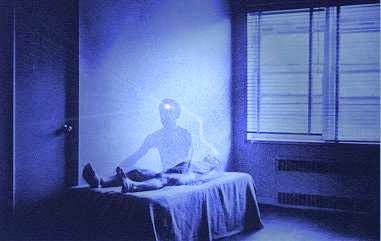 It seems very likely that our souls enter and exit physical bodies via the pineal gland (third-eye). Robert Monroe, Robert Bruce and other
 “Ring is not alone in his speculations. In the keynote address for the 1989 meeting of the International Association for Near-Death Studies (IANDS), Dr. Elizabeth W. Fenske, a clinical psychologist in private practice in Philadelphia, announced that she, too, believes that NDEs are journeys into a holographic realm of higher frequencies. She agrees with Ring’s hypothesis that the landscapes, flowers, physical structures, and so forth, of the afterlife dimension are fashioned out of interacting (or interfering) thought patterns. ‘I think we’ve come to the point in NDE research where it’s difficult to make a distinction between thought and light. In the near-death experience thought seems to be light,’ she observes.” -Michael Talbot, “The Holographic Universe” (246)
 Another decidedly “holographic” feature of NDEs is the commonly repeated notion that, in
  “In addition to those mentioned by Ring and Fenske, the NDE has numerous other features that are markedly holographic. Like OBEers, after NDEers have detached from the physical they find themselves in one of two forms, either as a disembodied cloud of energy, or as a hologram-like body sculpted by thought. When the latter is the case, the mind-created nature of the body is often surprisingly obvious to the NDEer. For example, one near-death survivor says that when he first emerged from his body he looked ‘something like a jelly fish’ and fell lightly to the floor like a soap bubble. Then he quickly expanded into a ghostly three-dimensional image of a naked man. However, the presence of two women in the room embarrassed him and to his surprise, this feeling caused him suddenly to become clothed … That our innermost feelings and desires are responsible for creating the form we assume in the afterlife dimension is evident in the experiences of other NDEers. People who are confined in wheelchairs in their physical existence find themselves in healthy bodies that can run and dance. Amputees invariably have their limbs back. The elderly often inhabit youthful bodies, and even stranger, children frequently see themselves as adults, a fact that may reflect every child’s fantasy to be a grown-up, or more profoundly, may be a symbolic indication that in our souls some of us are much older than we realize.” -Michael Talbot, “The Holographic Universe” (246)
 Perhaps the most holographic aspect of NDEs is the life review. Dr. Ring calls it “a holographic phenomenon par excellence.” Many NDErs themselves have used the term “holographic” to describe the experience. “It was an incredibly vivid, wrap-around, three-dimensional replay of my entire life,” said one NDEr, “It’s like climbing right inside a movie of your life,” said another. “Every moment from every year of your life is played back in complete sensory detail. Total, total recall. And it all happens in an instant. The whole thing was really odd. I was there; I was actually seeing these flashbacks; I was actually walking through them, and it was so fast. Yet, it was slow enough that I could take it all in.” Thus the experience is holographic both in its panoramic three-dimensionality and also in its incredible capacity for information storage. NDErs lucidly re-experience every single thought and emotion of not only their lives, but the thoughts and emotions of everyone else they ever came in contact with! They feel the joy of people who they treated kindly and the pain of people they treated poorly. No thought or emotion, theirs or anyone else’s they ever knew remains private.
 “In fact, the life review bares a marked resemblance to the afterlife judgment scenes described in the sacred texts of many of the world’s great religions, from the Egyptian to the Judeo-Christian, but with one crucial difference. Like Whitton’s subjects, NDEers universally report that they are never judged by the beings of light, but feel only love and acceptance in their presence. The only judgment that ever takes place is self-judgment and arises solely out of the NDEer’s own feelings of guilt and repentance. Occasionally the beings do assert themselves, but instead of behaving in an authoritarian manner, they act as guides and counselors whose only purpose is to teach. This total lack of cosmic judgment and/or any divine system of punishment and reward has been and continues to be one of the most controversial aspects of the NDE among religious groups, but it is one of the most oft reported features of the experience. What is the explanation? Moody believes it is as simple as it is polemic. We live in a universe that is far more benevolent than we realize. That is not to say that anything goes during the life review. Like Whitton’s hypnotic subjects, after arriving in the realm of light, NDEers appear to enter a state of heightened or meta-conscious awareness and become lucidly honest in their self-reflections. It also does not mean that the beings of light prescribe no values. In NDE after NDE they stress two things. One is the importance of love. Over and over they repeat this message, that we must learn to replace anger with love, learn to love more, learn to forgive and love everyone unconditionally, and learn that we in turn are loved. This appears to be the only moral criterion the beings use. The second thing the beings emphasize is knowledge. Frequently NDEers comment that the beings seemed pleased whenever an incident involving knowledge or learning flickered by during their life review. Some are openly counseled to embark on a quest for knowledge after they return to their physical bodies, especially knowledge related to self-growth or that enhances one’s ability to help other people.” -Michael Talbot, “The Holographic Universe” (250)
 “Many dying individuals have reported encounters with other beings, such as dead relatives or friends, ‘guardian spirits,’ or spirit guides. Particularly common seem to be visions of a Being of Light, which usually appears as a source of unearthly light, radiant and brilliant, yet showing certain personal characteristics such as love, warmth, compassion, and a sense of humor. The communication with this Being occurs without words, through an unimpeded transfer of thoughts. In the context of this encounter or outside of it, the dying individual can experience a partial or total review of his or her life, which almost always involves vivid colors and a three-dimensional, dynamic form. The message from this experience seems to be the realization that learning to love other people and acquiring higher knowledge are the most important values in human life.” -Stanislav Grof and Joan Halifax, “Human Encounter with Death” (154-5)
 EricDubay.com

