
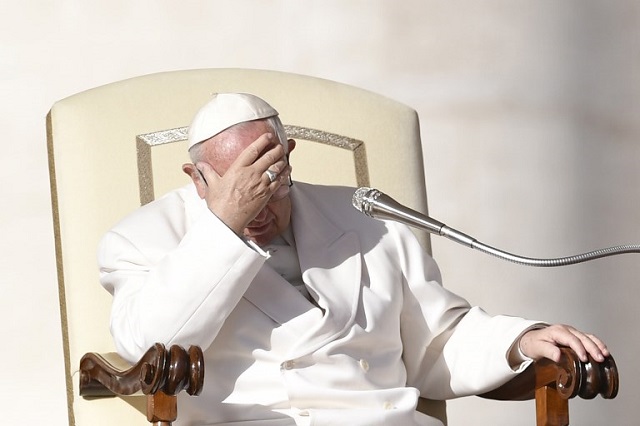
In his annual World Communication Day message held on the feast day of Francis de Sales, the patron saint of journalists, the Pope referred to Eve being fooled by the snake as “the first fake news”.
“We need to unmask what could be called the 'snake-tactics' used by those who disguise themselves in order to strike,” he said.
- Pope Francis compares scandal-seeking media to lovers of excrement
- Pope plans to wage war on fake news
-
High-profile Italians join fight against fake news
Fake news” was popularised as a phrase by Donald Trump during his victorious 2016 US presidential election campaign and first year in the White House.
Trump uses it as a barb towards what he believes is a mainstream media biased against him, but it has come to be used as a way of describing the proliferation of outlets and websites publishing invented news stories as a tool of political propaganda.
Pope Francis used the story of Adam and Eve, from the Old Testament's Book of Genesis, to highlight that “there is no such thing as harmless disinformation; on the contrary, trusting in falsehood can have dire consequences. Even a seemingly slight distortion of the truth can have dangerous effects”.
In the story, the snake convinces Eve and then Adam into eating the forbidden fruit from the tree of the knowledge of good and evil, an act which leads to God expelling them from the Garden of Eden.
READ ALSO: Italy debates fines and prison terms for those who spread fake news
“Spreading fake news can serve to advance specific goals, influence political decisions, and serve economic interests. The effectiveness of fake news is primarily due to its ability to mimic real news, to seem plausible,”
added Francis.
“The most radical antidote to the virus of falsehood is purification by the truth.”
In order to discern the truth from the lie, the Pope suggests that people look at the results and see “whether they provoke quarrels, foment division, encourage resignation; or, on the other hand, they promote informed and mature reflection leading to constructive dialogue and fruitful results”.
He also looked towards journalism as “not just a job” but “a mission”, and journalists as “protectors of news” who should promote a “journalism of peace”.
“I mean a journalism that is truthful and opposed to falsehoods, rhetorical slogans, and sensational headlines,” he said.
His message comes as Italy's political parties prepare for an election scheduled for March 4th. Italian President Sergio Mattarella has criticized the parties for making “irresponsible” promises, such as pledging sweeping tax cuts without outlining plans for where the lost revenue would come from.
READ MORE: Five Star Movement sidesteps claims of pro-Russia fake news
 Please whitelist us to continue reading.


