

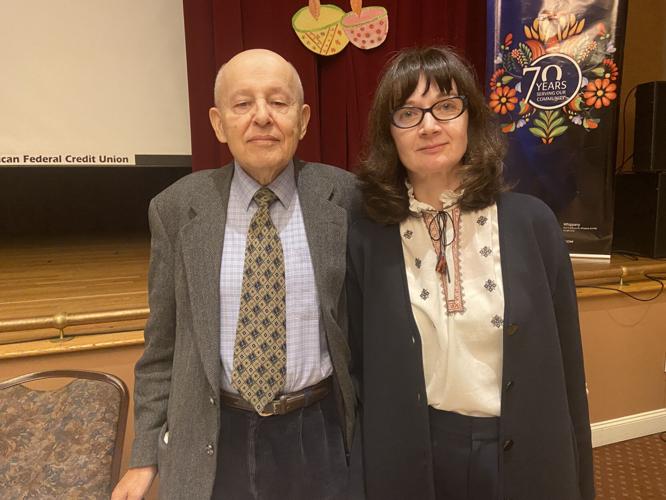

HANOVER TWP. - The Ukrainian American Cultural Center of New Jersey hosted experts on the Holodomor, a 1932-33 genocide in Ukraine, and its connections to current atrocities Sunday, Nov. 6.
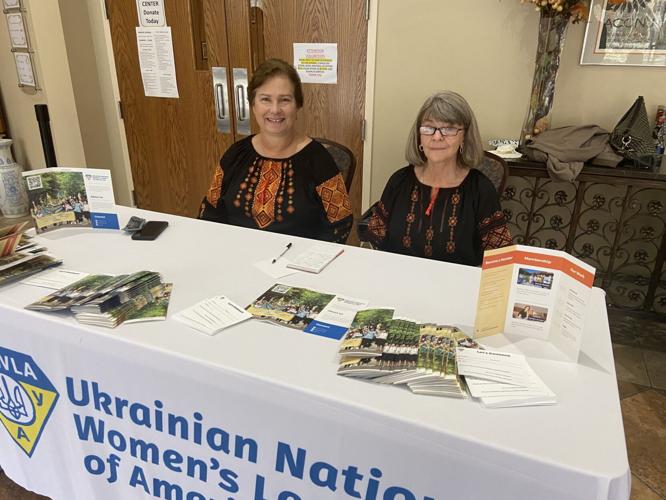
This was in commemoration of Holodomor Memorial Day which is the fourth Saturday of November, this year falling on Nov. 26. The event was hosted by the Ukrainian National Women's League of America.
The panel was moderated by retired international lawyer Victor Rud, a Ridgewood resident who talked about the connection to United States security interests between what’s going on in Ukraine now and what happened almost 90 years ago.
“The summary, I think, would be that people are not adequately aware that Russia’s occupation of Ukraine was key to the creation and viability of the Soviet Union, and we of course were directly conflicted with them,” Rud said. “And we’re seeing a repeat of it right now, both in terms of the tactics and the strategy that Russia’s using and the genocide that’s taking place right now in Ukraine.”
Among the speakers was Roman Serbyn, a retired professor at the University of Quebec at Montreal, who talked about Rafael Lemkin, a Polish lawyer who coined the term “genocide.”
Serbyn, who lives in Montreal, said Lemkin spoke at a big rally in New York City in 1953, and for the rally, he wrote a piece called “Soviet Genocide in Ukraine.” Serbyn said this was the first conceptualization of the genocide of Ukrainians in a holistic way.
“That is very important because unfortunately, the text was not known until early this century,” Serbyn said. “And most scholars, historians and politicians narrowed down the notion of Ukrainian genocide only to the famine because the Ukrainians called that famine “Holodomor,” “The Great Famine.” And when he introduced the notion of genocide, they concentrated on that.”
Serbyn said “Holodomor” is a combination of two Ukrainian words; these are “holod” which means famine and “mor” which means more.
The Holodomor was much more than a famine; it included a destruction of Ukrainian culture, intelligentsia and churches, and the perpetrators wanted a total destruction of Ukrainians but didn’t get what they wanted, he said.
University of Fresno professor Victoria Valko talked about how the intelligentsia in Ukraine was the first target of the Holodomor, and this is discussed in her 2021 book, “The Ukrainian Intelligentsia and Genocide: The Struggle for History, Language and Culture in the 1920s and 1930s.”
“It’s the extermination of culture, people,” Valko said about the Holodomor.
“And I argue in my book that the denial of the Holodomor as genocide and the rehabilitation of Stalinism in modern Russia and the revision of the past are the underlying reasons of the continuation of the current violence. And until this genocide is acknowledged, there is a danger that violence will escalate. So governments, world governments, if we all abide by the Genocide Convention and as human beings in the civilization, we say that it never again should happen anywhere in the world. We cannot be blind or not seeing that genocide is unfolding because we have the duty to prevent it.”
Contact Brett Friedensohn at [email protected].










(0) comments
Welcome to the discussion.
Log In
BE YOURSELF. We do not accept and will not approve anonymous comments. Kindly add your full name and hometown to the end of your comment.
Keep it Clean. Please avoid obscene, vulgar, lewd, racist or sexually-oriented language.
PLEASE TURN OFF YOUR CAPS LOCK.
Don't Threaten. Threats of harming another person will not be tolerated.
Be Truthful. Don't knowingly lie about anyone or anything.
Be Nice. No racism, sexism or any sort of -ism that is degrading to another person.
Be Proactive. Use the 'Report' link on each comment to let us know of abusive posts.
Share with Us. We'd love to hear eyewitness accounts, the history behind an article.